Get Full Government Meeting Transcripts, Videos, & Alerts Forever!
Get email alerts on the Townhouse Redevelopment topic
No spam. Unsubscribe anytime.
Hampden committee narrows focus on Townhouse options, sets April 1 follow-up meeting
Summary
The Town of Hampden Old Townhouse Committee reviewed survey results and historical research, debated a range of redevelopment and disposition options (keep, sell, lease, demolition, mixed-use and others), discussed cost ranges and funding (CPA and tax credits), and scheduled a follow-up meeting for April 1 at 6 p.m.
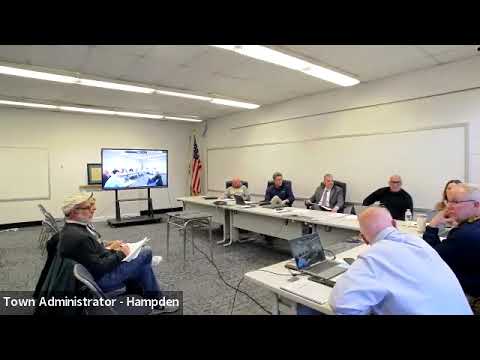
The Old Townhouse Committee of the Town of Hampden reviewed preliminary survey results and debated redevelopment options for the historic Townhouse on March 24, scheduling a follow-up meeting for April 1 at 6:00 p.m.
Chair (S1) opened the meeting and the committee’s presenter (S3) said 165 responses had been received to date and offered to circulate the raw data and a preliminary report for committee review: "We have a 165 responses," the Presenter said, noting the totals and demographic slices could change as more paper responses are tabulated. Committee members discussed using social media and a public forum to boost participation ahead of a planned community forum in April.
A preservation-minded presenter (S5) summarized earlier preservation work on the Townhouse, pointing to a 2000 historic survey by Marla Miller and explaining the National Register process, including review by the Massachusetts Historical Commission and potential state and federal tax credits. S5 said the Townhouse likely "has more than a 90% chance of getting accepted" on its merits and recommended scanning archival materials and consulting the Community Preservation Coalition for funding guidance.
Members pressed for concrete cost and scope numbers before recommending a path. During discussion the group cited several working figures raised in the meeting: an ADA-only package discussed in the meeting at roughly $2.5 million–$3 million; a phased or partial rehab approach versus an ‘‘all-in’’ rehabilitation described in prior materials at about $7 million–$8 million; and interim estimates of $4 million–$4.5 million to reach a usable condition for some purposes. Committee members cautioned these figures were preliminary and subject to updating.
Committee member (S4) walked the group through six redevelopment options from the master plan — keeping the building, mixed-use redevelopment, single-family subdivision, institutional/nonprofit reuse, demolish, or a ground lease/redevelopment agreement — and proposed that the committee analyze the six options further. Members debated grouping disposition strategies (sale, lease, redevelopment) and agreed to narrow the list to a smaller set (3–4) of top options to present to the Select Board and, ultimately, the town for a vote.
Several members also discussed whether and how to coordinate the Townhouse work with an adjacent firehouse project to capture efficiencies (shared site work, bays, asbestos abatement), and some suggested combining staging to lower carrying costs versus immediate sale. Committee members emphasized demolition is irreversible and that feasibility and finance should drive recommended options.
The committee recorded follow-up tasks including: circulating the raw survey data and preliminary analysis, scanning the historical survey and scrapbook materials for digital distribution, refining cost estimates and feasibility metrics, and preparing a master-plan presentation for May 11. A motion to schedule a follow-up meeting on April 1 at 6:00 p.m. was moved, seconded and approved (voice vote: "Aye").
The committee did not adopt a final redevelopment decision; members directed staff and volunteers to refine numbers, narrow the options, and return with a focused recommendation to the Select Board and the public at the next meetings.