Get Full Government Meeting Transcripts, Videos, & Alerts Forever!
Get email alerts on the Transportation topic
No spam. Unsubscribe anytime.
San Mateo County proposes speed-hump pilot on Coleman Avenue; residents warn of cyclist risks
Summary
San Mateo County Public Works proposed a tiered pilot beginning with three temporary speed humps on the county portion of Coleman Avenue, monitored for one year; residents at the virtual meeting supported action but urged shoulder repairs, enforcement and alternatives such as one-way or school-hour closures.
San Mateo County Public Works presented a tiered pilot to address safety on the unincorporated portion of Coleman Avenue and said it would start with traffic calming measures and monitor effects for about a year. Christophe Lisai, deputy director in Public Works, told attendees the county proposes three temporary speed humps near the county boundary to reduce vehicle speeds and preserve existing circulation.
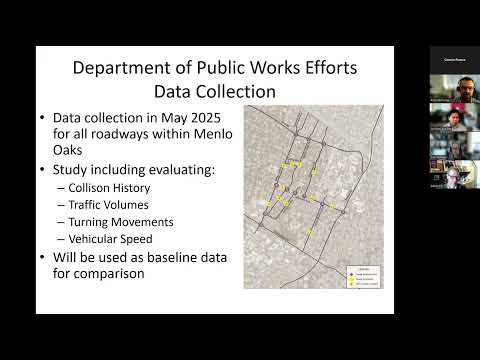
The county framed the pilot as a reversible, staged approach. Lisai said staff developed the tiers from a community-driven study that produced five alternatives and multiple outreach events. Tier 1 (traffic calming) was selected for initial implementation because it is lower impact and quicker to install; Tier 2 would be a one-way conversion and Tier 3 a no-through-traffic closure requiring progressively more analysis and community outreach. Lisai said baseline data were collected in May 2025 and the pilot would be monitored for about one year, with traffic counts, speed measurements, diversion analysis and a community survey informing next steps.
Residents spoke in favor of action but raised several recurring concerns. Jeff Schmidt, a city council member and Coleman resident, asked the county to pursue shoulder and pavement improvements in parallel so bicyclists are not forced into traffic. Multiple parents and cyclists, including Kevin Rennie and Michael Johnston, said speed humps and bollards can pose hazards to cyclists, especially young riders; Johnston cited international examples of serious crashes and urged careful design to avoid making the corridor more dangerous for bikes.
Other participants pushed for additional or alternative measures. A resident identified as Jim suggested designating Coleman primarily as a school pedestrian street or exploring time-limited closures during school hours. Ross Silverstein questioned the decision to start with the least disruptive option and asked whether a one-way pilot could create more continuous space for pedestrians and cyclists. Several speakers, including Francesca Segre, urged the county to clear brush and dead trees that block informal walking paths and reduce the need for structural road changes.
On enforcement, commenters noted limited local law-enforcement capacity; Lisai acknowledged the concern but said enforcement is outside the core pilot scope and that the county would consider coordination options. David Rubin warned of future traffic increases tied to nearby developments and asked whether the county would analyze longer-term traffic scenarios; Lisai said the current study addressed existing conditions but staff could explore future-flow analysis.
Lisai also told the meeting that California legislation allows lowering speeds adjacent to K–12 schools under certain conditions (including within 500 feet of a school) and that initial eligibility work identifies multiple Menlo Oaks segments as candidates for reduced school-zone speeds. The county reported recent actions on Coleman, including striping updates in August 2025, installation of ‘tough curbs’ and delineators in September 2025, and the May 2025 baseline data collection.
What happens next: Lisai said the county expects it can implement the tier 1 pilot within two to three months and will run the trial for about a year, collect data at comparable times of year and day to the baseline counts, run a community survey at the end of the monitoring period and then decide whether to keep, adjust, escalate to a higher tier or revert to prior conditions. A project link and a recording will be posted to the Coleman Avenue traffic-calming project site for further details and updates.
The meeting closed after participants reiterated concerns about shoulder conditions, cyclist safety and enforcement; staff said more detailed engineering and design work would follow before construction to limit unintended impacts on bicyclists and pedestrians.