Get Full Government Meeting Transcripts, Videos, & Alerts Forever!
Get email alerts on the Climate Policy topic
No spam. Unsubscribe anytime.
City administrators brief council on Climate Commitment Act obligations for municipal gas utility
Summary
City Administrator Chris Searcy told the Enumclaw City Council the city’s municipal gas utility is just above the CCA threshold and may face rising compliance costs; he recommended council consider policy guidance, possible grant seeking and coordination with other municipal utilities.
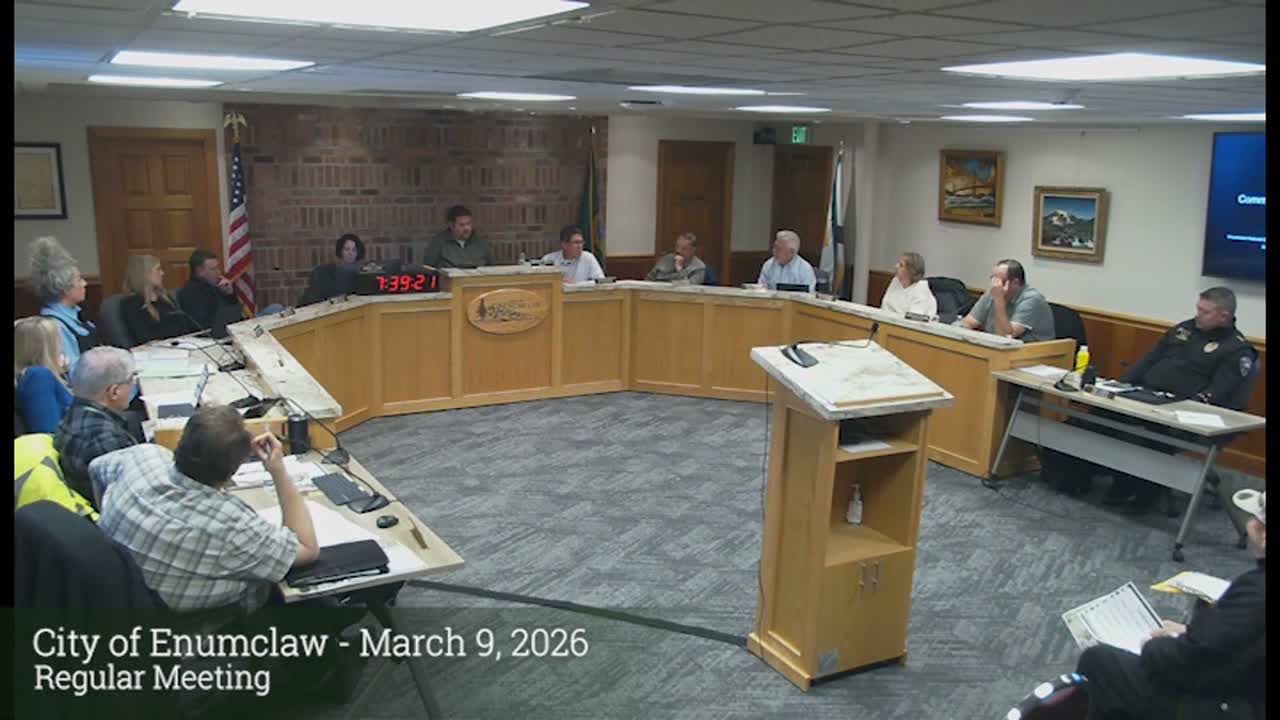
City Administrator Chris Searcy told the Enumclaw City Council on March 9 that the city’s municipal natural‑gas utility has been drawn into Washington’s Climate Commitment Act (CCA) compliance because the utility’s average emissions for 2023–25 were “a little over 25,000 metric tons,” placing it just above the program threshold.
Searcy, who led an informational workshop, said the CCA is a state cap‑and‑invest program that requires covered entities to hold allowances equal to their greenhouse‑gas emissions and that Ecology stages auctions and issues a shrinking allocation of no‑cost allowances over time. “We are just marginally over the threshold of being pulled into the program,” Searcy said, and he advised the council that the city’s practical goal would be to get below a 10 percent buffer under the threshold — roughly 22,500 metric tons — to avoid being pulled back in under Ecology’s rules.
Why it matters: the city must buy additional allowances at auction as its no‑cost allocation declines and a rising share is required to be consigned to auctions. Searcy said proceeds from auctioned allowances can be used to offset customer bill impacts, but the council should expect increasing out‑of‑pocket compliance costs over time and consider whether to fund decarbonization planning or programs.
Key details from the workshop: - Coverage and baseline: Ecology calculated the city’s baseline using the 2015–2019 period; Searcy said growth around 2020–2021 raised the city above the 25,000‑ton threshold and the city’s appeal was unsuccessful. - Allowances and billing: the city receives no‑cost allowances that decline over time; some allowances must be consigned to state auctions. Searcy described a two‑step charge process on customer bills: a forward estimate for the coming year and a later true‑up reflecting actual compliance costs. - Legacy vs. non‑legacy customers: customers who connected after July 25, 2021 (non‑legacy) do not benefit from auction proceeds and therefore face higher CCA charges. Searcy said about 98% of customers are legacy and about 2% are non‑legacy. - Cost signals: Searcy said the city’s first CCA year cost in 2023 was about $250,000 and recent annual costs are in the hundreds of thousands; he noted the program could push compliance costs above $1 million annually in later years depending on allowance prices and market linkage, but stressed projections depend heavily on future carbon prices and market linkage with other jurisdictions.
Council questions focused on near‑term budget impacts, the possibility of pursuing legislative relief, and coordination with other municipal utilities. Searcy said Ellensburg and Enumclaw are the two remaining municipal gas utilities in Washington and described discussions with Ellensburg about an alternative compliance approach that would place funds in a restricted account for decarbonization rather than participating fully in auctions.
Searcy recommended the council: review the materials, consider whether the city should pursue alternative compliance or legislative carve‑outs for municipal utilities, and return to the topic in May for more detailed direction. He also said additional staff or technical resources would be needed for any customer‑facing decarbonization program.
The workshop did not produce formal council direction; council members were asked to consider the information and provide policy guidance at a future meeting.