Get Full Government Meeting Transcripts, Videos, & Alerts Forever!
Get email alerts on the Zoning Detention Centers topic
No spam. Unsubscribe anytime.
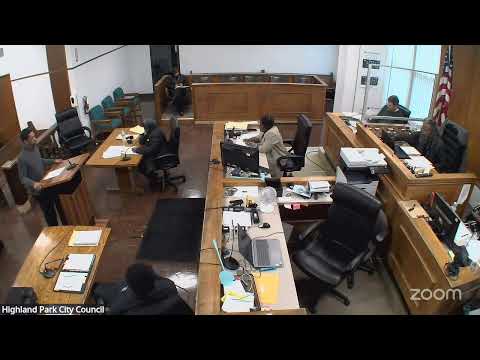
Highland Park workshop refers draft detention‑center zoning language to planning commission after legal review
Summary
At a Highland Park council workshop, legal advisers said the city's zoning ordinance already omits detention facilities and recommended clarifying definitions (including 'essential services') to prevent those uses; council members agreed to send revised language to the planning commission for public review, with a likely April 8 hearing.
At a Highland Park council workshop, members and legal advisers reviewed a proposed ordinance aimed at blocking federal detention facilities and agreed to refer clarified zoning language to the planning commission for formal review and a public hearing.
Mister Smith, who led the city's legal analysis, told the council the city's existing table of uses does not list detention centers, jails or prison sites and therefore those uses are presently not permitted. "Nowhere on that table will you find a detention center, a jail, a prison site," Smith said, and recommended reinforcing definitions (A, B and C in the draft) and tightening the definition of "essential services" so a detention facility could not be reclassified as a utility or essential service.
The clarification, Smith said, is intended to guide the zoning administrator and give the zoning board of appeals clearer criteria to deny efforts to fit a detention facility into another permitted use. "If we make those improvements, it'll be a stronger ordinance and protection for that," he said.
Council members pressed Smith on whether a local ordinance could stop the federal government from establishing a detention facility. Smith answered that federal preemption limits local authority: the ordinance may slow an effort and provide grounds to resist, but it may not definitively prevent federal action. "We are not able to stop the federal government from purchasing a building and operating that building," he said.
Several council members and the President raised practical concerns about litigation risk and fiscal exposure if the city tries to test the issue in federal court. The President warned a legal fight with the federal government could be prolonged and expensive, saying the city lacks the resources of larger jurisdictions that maintain dedicated legal divisions to test such policies.
Participants noted related actions in other Michigan cities. Smith and staff reported that the Detroit City Council adopted a resolution and that corporate counsel Conrad Mallett published a memo (dated Feb. 3) reviewing immigration enforcement and local policy; staff offered to distribute the Detroit reports and the corporate counsel memo to council members for review.
A council member moved to send the draft and the recommended definition changes to the planning commission for public hearing and recommendation. City staff and legal advised how the item could be added to the council agenda and circulated to planning staff. Smith said he expected the planning commission to meet on the second Wednesday (confirmed as April 8) and to conduct a public hearing; the commission's recommendation could return to the council as soon as next month, with a worst-case return in May.
The council agreed to send the clarified language to the planning commission, schedule a full workshop in April to review the Detroit materials and corporate memo, and ask planning and legal staff to prepare updated ordinance language. The President then called the workshop adjourned at 06:54.
The planning commission will handle the formal public hearing and make a recommendation to the council; any future formal action by the council will be reported after the commission completes its review.