Get Full Government Meeting Transcripts, Videos, & Alerts Forever!
Get email alerts on the Ais Overview topic
No spam. Unsubscribe anytime.
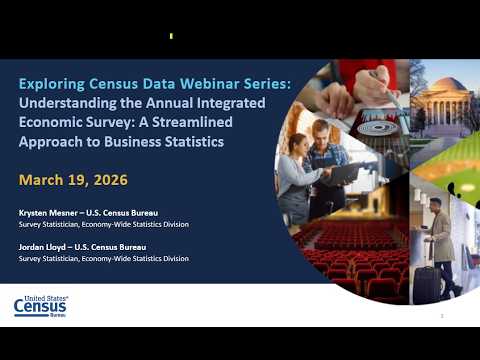
U.S. Census Bureau presents Annual Integrated Economic Survey, consolidating seven business surveys
Summary
Census Bureau presenters outlined the Annual Integrated Economic Survey (AIES), which merges seven annual business surveys into one to reduce respondent burden, expand geographic detail (state/division) and produce timely national and subnational economic measures; staff reviewed release timing and confidentiality protections.
The U.S. Census Bureau on its webinar described the Annual Integrated Economic Survey (AIES) as a newly designed annual business survey that consolidates seven legacy surveys into a single instrument to reduce reporting burden and improve data quality.
"The AIES is a newly designed survey developed by the US Census Bureau. It replaces and integrates 7 separate annual business surveys into 1 unified survey," said Kristen Messner, a survey statistician and methodologist at the U.S. Census Bureau. She told attendees the integrated approach will produce more comprehensive national and subnational data on business revenues, expenses and assets while cutting respondent burden.
Kristen said participation in the AIES is mandatory and that responses are protected under the Census Bureau's confidentiality rules. She tied the redesign to a 2018 National Academy of Sciences review that recommended consolidating annual economic surveys after noting declining response rates and budget pressures.
Census staff emphasized operational benefits: standardized electronic reporting, prefilled and validated data, greater use of administrative and historical records, and the potential to publish estimates at deeper geographic levels than were routinely available from separate legacy surveys.
On timing, Kristen outlined recent and upcoming steps in the release cadence: the 2023 AIES mailout occurred in March 2024; the Bureau published a preliminary "first look" in July 2025 and the main data release in February 2026. She said the 2024 mailout occurred in March 2025, with field collection completed in 2025 and anticipated 2024 data releases in summer 2026; the 2025 mailout is scheduled for March 2026 and the Bureau aims to speed publication for later cycles.
Why it matters: consolidating surveys gives policymakers, businesses and researchers a single, consistent annual source for business revenue, payroll, employment and capital information, with improved potential for state and divisional estimates that can better inform local and regional analysis.
The Census Bureau said experimental tables will be evaluated for promotion to regular products as quality metrics permit. The Bureau also plans outreach and explanatory materials — including infographics and America Count stories — to help nontechnical users interpret the new tables.
The webinar closed with an invitation to access documentation and the dataset at census.gov/ais and to send follow-up questions to census.askdata@census.gov. Kristen said the full 2023 methodology is posted on the AIES web pages for users seeking technical details.