Get Full Government Meeting Transcripts, Videos, & Alerts Forever!
Get email alerts on the Programmatic Agreement topic
No spam. Unsubscribe anytime.
Guam lawmakers press SHPO and federal partners over draft 2025 programmatic agreement, citing consultation and scope concerns
Summary
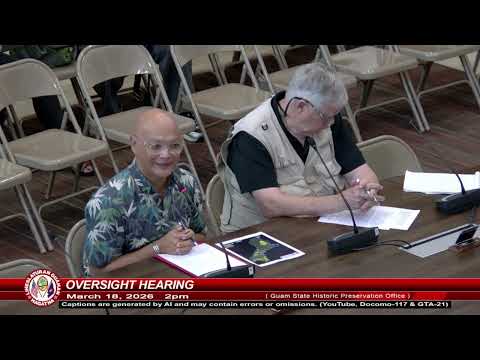
On March 18, 2026 the Guam Legislature held an oversight hearing on the draft 2025 programmatic agreement between Joint Region Marianas and the Guam State Historic Preservation Office. Lawmakers praised proposed technical updates (GIS sensitivity mapping, a faster ICRMP cycle) but criticized perceived gaps in early consultation, public notice, and protections when projects proceed before archaeological surveys are complete.
CHAMORRO — Guam legislators pressed the Guam State Historic Preservation Officer and federal partners on March 18 over a draft 2025 programmatic agreement (PA) intended to streamline Section 106 reviews of Department of Defense undertakings on the island.
Senator Shelly Cabo, chairing the oversight hearing, said the PA aims to reconcile Guam’s role in U.S. defense planning with its cultural stewardship responsibilities and asked whether the draft strengthens protection or merely expedites compliance. "This agreement seeks to streamline compliance with federal historic preservation requirements under section 106 of the National Historic Preservation Act," she said, framing the committee's review around consultation, mitigation and transparency.
Guam State Historic Preservation Officer Patrick Luhan told the committee the PA remains a draft open to comment and that his office has prioritized public submissions before sending materials to the federal Advisory Council on Historic Preservation. Luhan described planned edits — fixing a single-signature typo, adding a stipulation for traditional cultural properties, and improving public notice for medium- and high-sensitivity projects — and highlighted technical upgrades such as a data-driven sensitivity map and a shared GIS atlas. "Ever the optimist, I appreciate the attention this PA process has attracted," he said.
Dr. John Peterson, an archaeologist who served in Guam and elsewhere, endorsed the PA as a planning tool that can help manage cumulative impacts. He told the panel the new sensitivity maps are based on multiyear field data and that the PA calls for an updated installation cultural resource management plan (ICRMP) within two years of signing, then every five years thereafter — a faster cycle than the previous agreement.
Glenn Sineklis, acting administrator of Guam EPA, supported several PA improvements but warned the draft contains programmatic allowances that could let some activities proceed without full, project-specific Section 106 review. "These mechanisms create a real risk that impacts will be identified only after damage has already been taken place," he said, urging early coordination and continued federal support.
Several senators, led by Senator Sabina Perez, challenged SHPO on whether the drafting process amounted to meaningful consultation or merely solicited public comment after a draft was effectively complete. Perez said appendix materials lack property lists and the draft does not clearly identify how adverse impacts will be assessed or avoided. "Comment is after when everything is developed … Consultation is early on," she said, urging stronger, earlier inclusion of community and government stakeholders.
Lawmakers repeatedly raised scope questions: multiple speakers said the draft appears to extend from Navy undertakings to all Department of Defense projects on Guam, possibly covering newly acquired lands and activities not yet defined. SHPO and Dr. Peterson said the PA is intended to provide consistent standards across installations and to trigger a full Section 106-style review for medium- and high-sensitivity (yellow/red) areas, while allowing programmatic coverage for clearly low-probability work to avoid overwhelming staff workloads.
The panel also pressed for public-facing reporting. Senators asked whether quarterly reports and monitoring findings would be posted online and whether SHPO could make sensitivity maps publicly available where security permits. SHPO said he is pursuing an online portal and proposed a roundtable in about two weeks to review comments and suggested edits; he also reiterated that written comments are being accepted through the March 20 deadline and that his office would continue to accept input afterward.
The hearing surfaced two broad, competing priorities: lawmakers’ insistence on expanded consultation, transparency and safeguards to prevent irreversible loss of irreplaceable cultural sites; and SHPO’s emphasis on a data-driven, consistent framework to manage thousands of small and large federal undertakings without creating unsustainable review burdens.
The committee did not vote or take formal action. It scheduled follow-up work — including a roundtable and continued solicitation of written feedback — and left open the possibility of revisions or a new drafting process before any final signatory action.
What’s next: the committee aims to convene a roundtable within weeks; the public comment period identified during the hearing was March 20, 2026, and SHPO said he would consider additional written suggestions received thereafter.