Get Full Government Meeting Transcripts, Videos, & Alerts Forever!
Get email alerts on the Seabed Mining topic
No spam. Unsubscribe anytime.
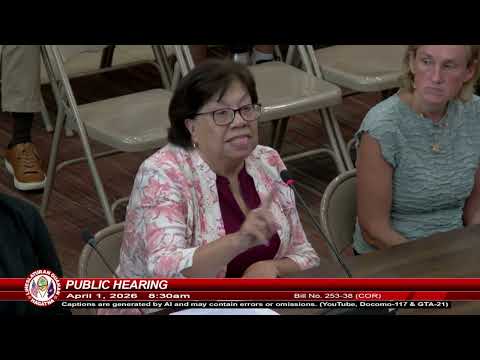
Guam committee hears strong support for bill to prohibit seabed mining
Summary
A legislative committee on April 1 heard unanimous public and agency support for a bill that would ban seabed mining and related port activity in Guam territorial waters; agency witnesses urged adding enforcement penalties, clearer territorial definitions and proactive port authority powers.
The Committee on Land, Environment, Housing, Agriculture, Parks, and Infrastructure heard extensive testimony on April 1, 2026, in favor of Bill 2‑53‑38, which would prohibit mining, extraction and removal of minerals from the seabed in Guam’s territorial marine waters and bar permitting for associated infrastructure.
The measure’s sponsors and nearly a dozen witnesses described risks they say are posed by recent federal activity. The Department of Agriculture’s director told the committee that the Bureau of Ocean Energy Management (BOEM) nearly doubled the area it is considering in the Marianas — from about 35,500,000 acres to roughly 69,100,000 acres — and that the western portion of the proposed area now comes as close as about 46 miles from Guam. "Bill 2‑53 represents the concrete legislative step that DOAG recommended in its January 2026 testimony," the director said, urging the legislature to adopt the territorial prohibition while tightening enforcement provisions.
Why the bill matters: witnesses — scientists, cultural practitioners, fishermen and community groups — argued that deep‑sea mining is poorly understood, could create sediment plumes and noise that travel hundreds of miles, and threaten fisheries, unique deep‑sea coral and migratory marine mammals. "For my family, the ocean is not just a resource. It's part of who we are," said Elsa de Molinara of the University of Guam Center for Island Sustainability, testifying that cultural continuity and food security are at stake.
Key technical recommendations from the Guam Department of Agriculture included adding a civil penalty structure and designating an enforcing agency; broadening the bill’s port‑deterrence authority so the Port Authority may act on credible information (not only upon federal notice of a violation); defining "territorial marine waters" (for example up to 3 nautical miles from baseline) to remove interpretive ambiguity; and specifically prohibiting use of Guam ports, harbors and anchorages as logistical bases for mining operations in adjacent federal waters unless authorized after full consultation.
Public commenters emphasized procedural concerns and regional solidarity. Monica Flores of Potehi Guahan described community organizing and legal workshops and warned that federal rule changes could shorten environmental review timelines; student and social‑work witnesses urged that affected communities be meaningfully consulted.
The committee’s discussion focused on enforcement, the adequacy of BOEM’s outreach and the need for coordination with neighboring jurisdictions. Lawmakers and witnesses cited a large public record: "we received over 65,000 comments," multiple speakers noted.
There was no final vote. The sponsor and the committee said they would continue to work on the bill and that committee staff will accept additional written testimony for the committee report before the next session.