Get Full Government Meeting Transcripts, Videos, & Alerts Forever!
Get email alerts on the Professional Ethics topic
No spam. Unsubscribe anytime.
State bar governors sign pledge on legal independence, agree to sponsor ABA resolution
Summary
The Washington State Bar Association Board of Governors voted to sign a National Conference of Bar Presidents pledge endorsing core legal values and, after separate debate, voted to sponsor a related American Bar Association resolution; the sponsorship vote was tied and carried by the president's deciding vote.
The Washington State Bar Association Board of Governors voted to sign a national pledge to "preserve the independence of the legal profession and the judiciary" and later agreed to sponsor an American Bar Association (ABA) resolution advancing that pledge.
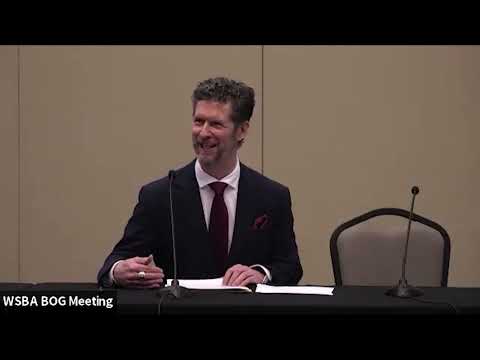
Patrick Palace, identified in the meeting as president of the National Conference of Bar Presidents (NCBP), presented the pledge and urged the Board to authorize the state bar president to sign on the association's behalf and to sponsor the ABA resolution. "As the president of the National Conference of Bar Presidents, I get a bit of a unique view to look across the country," Palace said, describing the pledge as a short document that gathers core professional values — rule of law, judicial independence, access to justice and ethical leadership — into one statement.
Governors debated whether the pledge added new obligations beyond existing oaths and prior statements. One governor raised concerns about "statement fatigue," asking what the pledge would add to prior ABA and bar statements. Others, including past presidents and governors, said repetition of core values could reassure members and the public. "Core values that are at the heart of our democracy…bear repetition," a past president said.
Governor Jordan Couch moved that the Board "sign on as the board of governors of the Washington State Bar Association" to the pledge; the motion was seconded by incoming president-elect Kari Petrasic. After debate the Board took a roll-call vote and approved the motion; the clerk announced the motion "passes with one no vote." The board recorded a formal roll-call while members explained their reasoning, with supporters citing professional duties and critics urging caution about speaking for all mandatory-bar members.
Couch then moved that the Board sponsor the ABA resolution that mirrors the pledge and seek to have it placed before the ABA House of Delegates. That motion prompted procedural questions about who must be listed as sponsor for the ABA (state bars, sections or other entities), how delegates would carry and potentially amend the resolution at the ABA meeting, and whether the board could withdraw sponsorship later. Board members were told sponsors can negotiate wording, that sponsors can withdraw their names if amendments change the text substantially, and that delegates typically represent the Board's adopted position.
A roll-call vote on sponsorship resulted in a tie. After a short recess, the board president cast the deciding vote in favor of sponsorship, and stated the Board retained the option to withdraw sponsorship later if necessary. "Before we adjourn, we had a tie vote and I would vote yes so that the sponsorship will go on," the president said, and announced plans for executive-committee follow‑up and possible special meetings if substantive issues arise in the ABA process.
The meeting record shows two distinct formal actions: the Board approved signing the NCBP pledge (the motion passed with one dissent) and the Board approved sponsoring the ABA resolution after the president broke a tie. Board members asked for additional briefings and recommended involving the bar's delegates in any next steps so the Board could set parameters (for example, to direct delegates to oppose any substantially amended version). The president and staff said the Board could withdraw sponsorship later if the final ABA text changed in ways the Board did not support.
Next steps noted in the meeting included follow-up with the bar's ABA delegates, possible drafting or word‑smithing of the resolution if the Board remained a sponsor, and monitoring the ABA schedule and deadlines for filing and sponsorship. The ABA House of Delegates consideration was identified in the meeting materials as scheduled for its August meeting in Chicago; the presenters noted a filing deadline in March or early April for sponsor designation.
Votes at a glance: the Board approved a motion to sign the NCBP pledge as its governing body (motion passed with one 'no'); later, a motion to sponsor the ABA resolution passed after a tie was broken by the president's vote. The Board emphasized that sponsorship does not irrevocably bind the association and that sponsorship can be withdrawn if sponsor(s) conclude later amendments are unacceptable.