Get Full Government Meeting Transcripts, Videos, & Alerts Forever!
Get email alerts on the School Budget topic
No spam. Unsubscribe anytime.
Millcreek Township SD presents draft 2026 budget, proposes 4.3% tax increase and warns of $1.6M shortfall
Summary
At a board meeting, a presenter outlined a draft 2026 budget for Millcreek Township SD that includes a proposed 4.3% tax increase, staffing changes and investments in technology and transportation; after earmarks the district projects a true deficit of about $1.6 million for the coming year.
The Millcreek Township SD board heard a presentation on the district’s draft 2026 budget, where the Presenter said the plan includes a proposed 4.3% tax increase and projects a near-term funding gap once certain earmarks are counted.
“If we went to the Act 1 index every single year, we'd be generating $8,300,000 more in revenue a year,” the Presenter said, using a multi-year comparison to explain the district’s constrained revenue position relative to other Erie County districts.
The Presenter framed the budget around three facts: heavy reliance on local revenue, rising costs tied to special education and multilingual-learner (MLL) growth, and limited control over major drivers such as salaries and benefits. He said the district’s revenue mix is roughly 65% local, 33% state and 2% federal, with real-estate taxes comprising about 51% of revenue.
Enrollment trends and mandated staffing ratios featured prominently. The Presenter said MLL enrollment rose from about 1.4% in 2015 to 6.1% today and special education grew from 15% to 21.3%, increasing the need for specialized staff and higher-cost placements. The budget adds positions including an autistic teacher and two aides, a life-skills aid and an MLL aid; it also funds additional custodial coverage tied to a new auditorium at McDowell.
To offset pressures the draft proposes program adjustments and some cuts: several teaching positions and stipends were eliminated, while a small number of extracurricular stipends were added for new programs such as flag football and girls wrestling. The Presenter said the board previously approved adding $80,000 annually to the budget for those changes.
The administration proposed a $36,000 investment in an AI document-processing tool (Canvas) to automate invoice matching and reduce data-entry errors, and noted transportation costs are rising as the district outsources routes because it lacks drivers. The Presenter said the district budgets 62 routes but currently has 54 drivers and that use of vans for special needs and homeless transport rose from roughly 500 days to about 1,800 days this year.
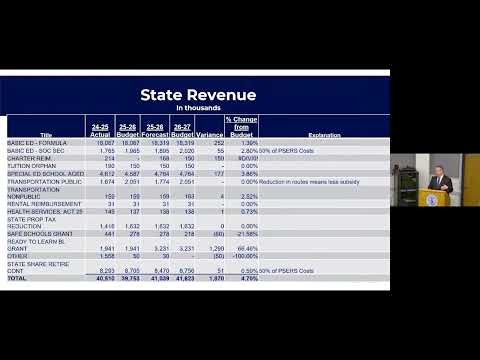
On revenues, the Presenter said the district expects a roughly $1.29 million increase from the state 'ready to learn' block grant and a $150,000 charter-school reimbursement; at the same time investment earnings were down about $113,000 and some local revenue streams (e.g., a planned credit-card rebate) did not materialize, reducing other local revenue by about $341,000.
Explaining the bottom line, the Presenter said the forecast shows an operating loss of about $864,000 for the current year and $662,000 the following year. After accounting for a board motion that earmarks 25% of certain investment and participation revenues for extracurricular-facility maintenance, he said the district’s "true" deficit is closer to $1.6 million for this year and $1.4 million next year.
The Presenter walked through fund-balance projections, saying the district would still end the 26–27 year with an unassigned fund balance near $9.9 million (about 8% of expenditures), a capital-projects fund of roughly $9.3 million, a committed fund of about $6.4 million (partly earmarked for the MAC stadium project), and an assigned IT fund around $2.5 million — yielding a total fund balance a little over $28 million.
A board member asked for clarification on healthcare costs. The Questioner asked why a line showing an $866,000 increase appeared while a $1 million savings from a new plan had been discussed; the Presenter said the $1 million represents plan savings that reduce what would otherwise have been a roughly $2 million increase, leaving a net $866,000 increase compared with last year’s budget.
The Presenter said the administration will bring a proposed final budget to the board in April and seek final approval in May, and agreed to distribute the presentation materials to board members for review.
What happens next: the board will review the proposed final budget in April and is scheduled to vote on a final budget in May.