Get Full Government Meeting Transcripts, Videos, & Alerts Forever!
Get email alerts on the Brown Act Training topic
No spam. Unsubscribe anytime.
Town attorney briefs Corte Madera Town Council on Brown Act, social media and public records
Summary
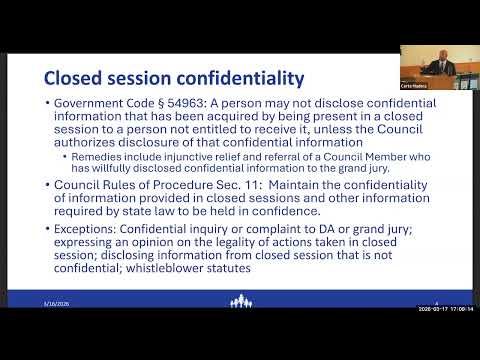
Town attorney Richard Piorota led a Brown Act and governance training for the Corte Madera Town Council, stressing closed-session confidentiality, social-media limits on serial communications, public-comment practices, and that text messages or emails on personal devices about town business are public records.
Richard Piorota, the town attorney from Redwood Public Law, delivered a focused Brown Act and governance training to the Corte Madera Town Council on March 17, reviewing closed-session confidentiality, limits on social-media exchanges among council members, and public records rules for personal devices.
Piorota told the council that "all information in closed session is confidential unless authorized to be disclosed by a majority of the council," citing Government Code procedures and remedies for unauthorized disclosure. He said disclosures authorized in closed session must be announced later in open session and that violations can lead to injunctive relief or other legal remedies.
The training covered social-media restrictions enacted by the legislature and reflected in Gov. Code §54952.2, which Piorota summarized as prohibiting a majority of the council from using a social platform to discuss town business. "A majority of the council cannot use a social media platform to discuss among themselves town business," he said, and cautioned against serial communications and even reactive emoji responses that could imply inter-member coordination.
Piorota also reviewed public participation rules, including pandemic-era changes incorporated into practice, and recommended consistent time limits and that follow-up questions be managed through the chair or staff to preserve equitable opportunities for commenters. He advised that council responses to open-time speakers be handled carefully to avoid unintended extensions of a speaker’s allotted time.
On records and communications, Piorota emphasized the California Supreme Court precedent that texts and emails on personal devices that relate to town business are public records subject to disclosure under the Public Records Act. He advised using town email accounts for town business and treating personal-device communications as potentially discoverable when they concern municipal matters.
The attorney explained practical steps to reduce Brown Act risk: avoid sharing other members’ positions in preparatory emails, consider BCC practices for staff pre-reads, and avoid hub-and-spoke or daisy-chain sequences of contacts that could amount to a quorum deliberation. He advised that attorney–client privilege generally applies to communications from the town attorney to council members, but the privilege is held by the council as a whole.
Piorota closed by reviewing basic parliamentary procedure (calling the question, motions, amendments), council–manager roles per the town’s municipal code, and ethical obligations including duty of loyalty and fiduciary duties over public funds. The training concluded after a period of council questions and brief discussion.