Get AI Briefings, Transcripts & Alerts on Local & National Government Meetings — Forever.
Department of Education details State Personnel Development Grants competition, $7.3 million available
Loading...
Summary
The U.S. Department of Education outlined application requirements and deadlines for the State Personnel Development Grants competition (listing 84.323A), including a June 16 deadline, $7,301,695 in total funding, minimum award levels and a required absolute priority on career pathways and registered educator apprenticeships.
Jennifer Coffey, an official with the U.S. Department of Education, walked prospective applicants through the State Personnel Development Grants competition (listing 84.323A) during an applicant-orientation webinar.
"If you are considering applying for this grant, you are in the right place," Coffey said, and she noted the application notice and instructions (ANI) on Grants.gov are the authoritative source for program requirements. Coffey said the ANI became available April 15 and set the application deadline at 11:59 p.m. Eastern on June 16.
Why it matters: The program, authorized by the Individuals with Disabilities Education Act (IDEA), is intended to help State Educational Agencies reform personnel preparation and professional development to improve outcomes for children with disabilities. The Department estimated total funding of $7,301,695 and said it could make about seven awards with a five-year project period.
Key details applicants must plan for: Coffey said states (and other SCAs) must request at least $500,000 per year for five years; outlying areas’ awards will not be less than $80,000. She emphasized that entities receiving new State Personnel Development Grant funds in fiscal year 2026 are ineligible to apply for this competition. No cost sharing is required, and grantees may use an applicable indirect cost rate.
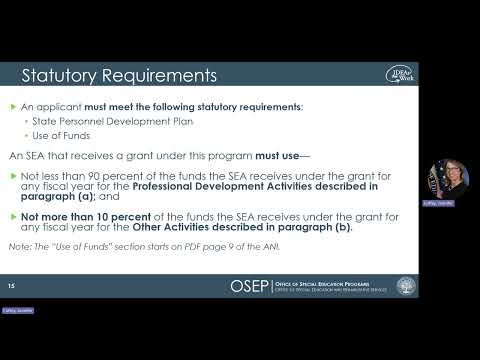
Use-of-funds and partners: Grantees must use at least 90% of annual funds for professional development activities described in paragraph A and no more than 10% for activities in paragraph B. Each year of the grant (including any no-cost extension year) must include a contract or subgrant with at least one local educational agency, one institute of higher education and at least one parent training and information center or community parent resource center; other public or private entities, including Part C lead agencies, may also be subawardees.
Absolute priority and activities: The competition has one required absolute priority this year, titled "Career Pathways and Workforce Readiness." Coffey described allowable approaches including developing or expanding registered educator apprenticeship programs that lead to certification; creating targeted pathways for instructional assistants, paraprofessionals, substitute teachers, career changers and others already employed; aligning apprenticeships with state licensure and shortage areas; and promoting earn-and-learn models with paid work experience and wage progression.
Program measures, evaluation and reviewer expectations: Applicants must describe data collection and reporting methods for Government Performance Results Act (GPRA) program measures, including implementation-fidelity measures, cost measures and outcome measures that show improvements for children with disabilities. Coffey said each grantee must conduct an independent evaluation and describe how its project will institutionalize practices into ongoing programs. Selection criteria peer reviewers will use include significance (up to 20 points), project design (up to 25 points), adequacy of resources, management plan quality and project evaluation (up to 25 points).
Budget and submission tips: Coffey highlighted that the application budget form permits travel for a two-day project director conference and a 1.5-day SPDG meeting in Washington, D.C., each year, and that applicants should include $6,000 annually for support of the program network and website. Applications must be submitted electronically on Grants.gov; narrative sections and attachments should be uploaded as read-only PDF (preferred) or Word files. Applicants must have a unique entity identifier (UEI) and taxpayer identification number (TIN) and maintain active registration in SAM.gov. Coffey advised registering early (Grants.gov can take five or more business days to process) and submitting well before the deadline.
Contact and next steps: Coffey encouraged applicants to read the ANI in full, consult the CEEDAR Center resources on registered teacher apprenticeship programs, and contact her with questions at the email provided during the webinar. She said she will reply within 24 hours.
The Department plans to post the slide deck on Grants.gov and host the webinar video on the Department’s YouTube site and the SPDG landing page on Ed.gov.