Get Full Government Meeting Transcripts, Videos, & Alerts Forever!
Get email alerts on the Community Engagement topic
No spam. Unsubscribe anytime.
Keizer council and community diversity committee outline 2026 outreach goals, prioritize accessibility
Summary
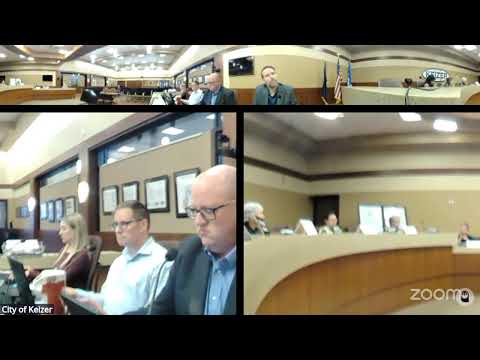
At a March 30 joint work session, Keizer City Council and the Community Diversity & Engagement Committee reviewed 2025 accomplishments and set 2026 goals focused on off-site meetings, neighborhood outreach, volunteer recruitment and technology-based accessibility (closed captioning and interpretation via streaming).
KEIZER, Ore. — Keizer City Council and the Community Diversity & Engagement Committee met in a joint work session March 30 to review 2025 accomplishments and lay out a plan for 2026 focused on outreach, inclusion and lower-cost accessibility solutions.
Committee members and staff described a mix of activities planned for the year: three off-site neighborhood meetings, expanded guest-speaker programming, distribution of outreach rack cards at high-traffic community locations, volunteer recruitment and a training video expected for review in May. The committee also discussed a neighborhood-led pilot for crosswalk safety flags and a plan to return the pilot concept and any funding allocations to council for formal approval.
"What we're doing through the streaming and our streaming services is complying with that," said the Chair, explaining that the city can enable closed captioning on streamed meetings to meet ADA obligations while reducing recurring interpreter costs. Staff described the city’s current practice of attempting to secure an interpreter when requested and said staff had not forwarded a formal recommendation back to council because the committee had not proposed changes to existing services.
Staff and committee members discussed the cost implications of broadcast services and funding constraints. "We're on a $100,000, you know, for broadcasting," a staff member said, noting that rules governing PEG funds changed after the franchise renewal with Comcast and that prior flexibility to use PEG funds for operations was limited. The committee is exploring autonomous captioning and multi-language streaming options to expand access beyond English and ASL while reducing ongoing operational costs.
Members stressed the value of using demographic data to turn outreach into action. "If we know this demographic, we say, 'We've got 30% Hispanic Latino community — what are we doing to reach out to that?'" one council member said, urging the committee to pair demographic reports with concrete outreach plans so translation and staff time are used effectively.
The committee also updated logistics for outreach materials: rack cards were reported ready for printing and distribution to city venues, the cultural center and nonprofit partners. Volunteers and neighborhood associations will carry materials at events, and staff asked the committee to identify high-traffic distribution points.
Next steps: the CDEC will refine measurable success criteria for outreach, check facility availability for scheduled events, circulate the training video script for preview and bring a recommendation on accessibility practices (closed captioning vs. in-person interpreters) to a future staff update or council report.