Get Full Government Meeting Transcripts, Videos, & Alerts Forever!
Get email alerts on the School Facilities topic
No spam. Unsubscribe anytime.
Othello board briefed that high school will qualify for state SCAP funds; eligibility roughly $50M today
Summary
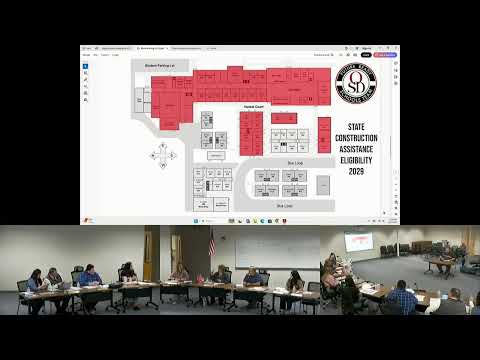
The Othello School District heard a Future Ready Schools briefing showing Othello High School will qualify for State Construction Assistance Program (SCAP) eligibility beginning in 2029, with current eligibility estimated at about $50 million and projected to rise to $50–$55 million, Dr. Meek said.
At a regularly scheduled Othello School District meeting, the board received a Future Ready Schools briefing from Dr. Meek explaining how the states State Construction Assistance Program (SCAP) could support modernization or replacement of Othello High School.
Dr. Meek told trustees the district qualifies under two SCAP pathways: the 30-year modernization window and an "unhoused students" calculation based on square footage per student. He said Othello High Schools last major round of projects finished in 1999, meaning the school will enter the 30-year modernization eligibility window beginning in 2029.
Why it matters: SCAP provides state-funded assistance to districts that pass local bonds and meet program criteria. The states formula uses a per-square-foot "current cost allocation" and a district-specific funding-assistance percentage; the allocation does not represent full construction cost but is a rate used to compute eligibility.
Key details from the presentation: Dr. Meek said the district qualifies for about 137,000 square feet of SCAP eligibility. The presenter reported the state's current cost allocation at $399 per square foot, stated the districts funding-assistance percentage as "90 or 82%," and said a soft-cost factor of 12.5% is applied. Using those inputs, Dr. Meek estimated the districts current SCAP eligibility at roughly $50,000,000 and projected it could rise into the $50 million to $55 million range by 2029 as the state allocation increases.
Board discussion focused on trade-offs between renovating the existing campus and building a new facility. Dr. Meek and trustees discussed practical implications: if the district vacates the existing high school and leaves it on the instructional inventory, that could make the district appear to have more high-school capacity than needed and alter future eligibility calculations. Dr. Meek said vacated buildings typically must be removed from the instructional inventory or reclassified as noninstructional to avoid that problem; as an example he cited DOHS being marked as noninstructional while the district retains ownership.
Trustees and meeting participants raised financial and design questions. One trustee warned that delay increases costs and cited a prior $30 million bond in 2007; another said the $200 million estimate for a new high school could grow over time. Dr. Meek noted that front-end estimates are per-square-foot and that design choices (for example building up rather than sprawling out) can yield savings. He also noted the 1,600-student assumption used in the estimate and suggested the district still needs to determine an appropriate target enrollment for any new or renovated facility.
Dr. Meek described alternative reuse options for parts of the campus (administration offices, preschool, food services, skill-center concepts), but warned that converting a building into a state-hosted skill center (CBTech) would involve separate state funding and likely a proposal process; most skill centers are new construction rather than conversions.
Next steps: The Future Ready Schools committee will continue to meet; Dr. Meek said the group will provide regular monthly briefs and the next committee meeting is May 12. Trustees asked staff to provide more detailed cost breakdowns and web links where the public can follow planning updates.
The presentation and discussion did not include a formal vote on a project or bond. The board recessed later for an executive session to discuss a personnel matter.