Get Full Government Meeting Transcripts, Videos, & Alerts Forever!
Get email alerts on the Opioid Settlement Allocation topic
No spam. Unsubscribe anytime.
Iowa officials outline how counties can use opioid settlement funds as HHS and AG issue grants
Summary
State HHS and the Attorney General's office briefed county officials on settlement timelines, reporting requirements and grant opportunities created by House File 1038, including HHS awards and an AG funding opportunity that together aim to direct state shares of opioid settlement dollars back into local services.
Iowa health and legal officials told county leaders on the March ISAC webinar that counties should map settlement spending to the approved uses in Exhibit E and take advantage of new state grant opportunities created by House File 1038.
Kevin Gabbard, clinical policy director for the Division of Behavioral Health at Iowa Department of Health and Human Services, said House File 1038 (passed in 2025) gave the state its first access to accumulated state shares of opioid settlement money. "Per the legislative language, $29,000,000 was set aside for specific earmarks," Gabbard said, and the remaining funds were divided between HHS and the Attorney General's office. He said the legislation directs roughly 75% of the state's allocation to HHS and 25% to the AG's office for distribution and programs.
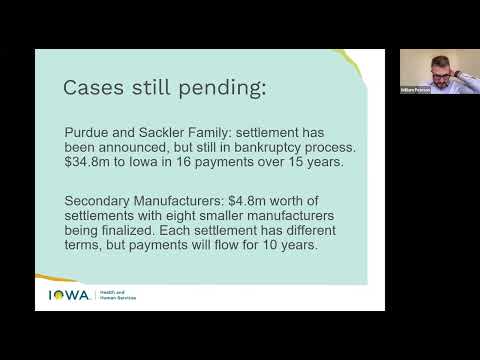
Bill Pearson, an assistant attorney general who works on the settlements, explained how settlements are divided: "50% goes to the state, 50% goes to the counties," with county shares then allocated on a per-capita basis. Pearson urged counties to consult the settlement schedules and the MOU documents posted on the settlement administrator's site to find their exact estimated payments.
HHS and the AG have begun distributing state funds. Gabbard said HHS released an initial request for proposals late last year, allocated roughly $7 million across 10 awards, and is preparing a second cohort of about $7 million that it expects to post in April. "We have 53 total applications" in the first round, he said, and noted HHS is evaluating proposals in coordination with other stakeholders.
Pearson described the AG's program as broadly open to applicants offering services aligned with Exhibit E. "We're looking for applications of all sizes," Pearson said, and added the AG intends to make about $20 million available between now and 2030 through its program. He said AG staff will review applications on a rolling basis and encouraged organizations large and small to apply.
The presenters emphasized that counties should document how each expenditure maps to Exhibit E abatement strategies to reduce later questions about eligibility. Monica Wilkie Brown, opioid response grant project director at HHS, said county reporting to the AG's office shows absolute spending has grown but the percentage of total settlement funds expended remains low, and clearer detail on reports will protect counties during any compliance reviews.
The meeting organizers said they would circulate the slide deck and links to settlement documents, county payment spreadsheets, and the HHS and AG application portals. County officials were advised to consult their county attorneys for legal questions about allowable uses.
The ISAC peer meeting closed with an invitation to send follow-up questions and a reminder that the next peer-sharing webinar is scheduled for May.