Get Full Government Meeting Transcripts, Videos, & Alerts Forever!
Get email alerts on the County Budget topic
No spam. Unsubscribe anytime.
Department of Management outlines fiscal 2027 county budget deadlines, levy limits
Summary
Carrie Johnson of the Department of Management summarized the fiscal 2027 county budget process, key dates (enter proposed tax by March 5; mail notices by March 15; file adopted budget by April 30; protest deadline May 10), types of funds and how levy‑limit calculations under House File 718 affect counties’ maximums.
Carrie Johnson with the Department of Management reviewed the fiscal 2027 county budget process and key statutory deadlines during a recorded webinar, telling attendees how to calculate levy limits and where to file notices and adopted budgets.
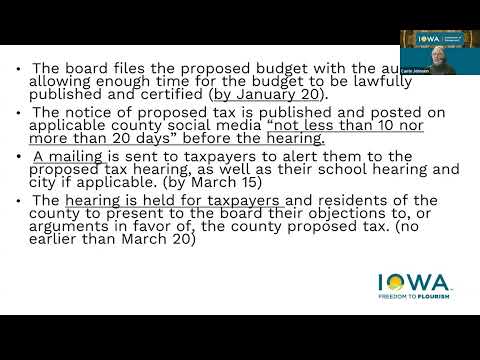
The session laid out the calendar counties must follow: enter proposed property‑tax askings in the state system by March 5 at 4 p.m.; mail the taxpayer notice by March 15; hold the proposed‑tax hearing (not earlier than March 20); publish and hold the full budget hearing (10–20 days’ notice); adopt the budget and file it by April 30; and note that citizens may submit a budget‑protest petition (100 signatures for a county) to the county auditor by May 10.
Why it matters: those dates create hard procedural limits. Johnson emphasized that figures published in the proposed‑tax notice form a legal ceiling: “By March 5 at 4 p.m., you’ve got to know your property‑tax asking,” she said, adding that counties may reduce the asking later in the process but may not increase it above what was published.
Johnson described the two broad categories of county funds and how budgets are organized: general fund, special revenue (for narrowly defined purposes such as rural basic or secondary roads), capital projects, debt service and permanent funds, plus non‑budgetary agency/ fiduciary funds the county administers for other entities. She noted that taxable value and assessment limitations determine how much revenue a county can raise from property taxes; for FY27 she gave the assessment percentages used for different classes of property and explained a two‑tier approach for commercial property.
Johnson also explained recent legislative and formula changes that affect levy calculations. House File 718 removed the previous option to exceed basic levy limits by publishing an extra notice; going forward, counties must obtain voter approval to exceed basic levy caps. She walked through the Department’s reduction factors that shave potential revenue based on taxable‑value growth (no reduction under 2.75% growth; 1% for >2.75–4%; 2% for >4–6%; and 3% for >6%), calling the adjustment a reduction in the dollars a county may capture rather than a direct percent cap on revenue.
The webinar included practical system steps: counties must enter their proposed property‑tax asking and hearing date into the Department of Management’s online budget system by March 5 so the state can produce the required mailers and notices; the system will block increases above the published asking and will perform the limitation calculations automatically. Johnson advised counties to upload proofs of publication and the signed adopted budget in the system by April 30.
On citizen participation and appeals, Johnson noted that the budget protest process requires a petition with at least 100 signatures for a county and must be submitted by May 10; the state appeal board would then hold a public hearing on the protest.
Johnson closed by offering to share slides and spreadsheets and pointed attendees to the ISAC website for posted materials and historical county tax‑rate files, adding that department staff (including Ted Nellison and John Parker) are available to answer specific questions.
The Department of Management will finalize its tax‑rate certification by June 15 and county auditors will provide tax lists to county treasurers by June 30, after which adopted budgets and tax rates are implemented for the fiscal year.