Get Full Government Meeting Transcripts, Videos, & Alerts Forever!
Get email alerts on the Wildfire Resiliency Code topic
No spam. Unsubscribe anytime.
Severance adopts Colorado Wildfire Resiliency Code, council cites compliance and limited local map reach
Summary
The Severance Town Council voted unanimously to adopt the 2025 Colorado Wildfire Resiliency Code and its map, saying adoption keeps the town eligible for state funding and grants while enforcement details and map boundaries will be refined over coming months.
Severance’s Town Council voted to adopt the 2025 Colorado Wildfire Resiliency Code and the accompanying map on March 24, 2026, to keep the town in compliance with state law and preserve access to transportation and mitigation grants.
Town Attorney Chris Rogers told the council the state set a statutory schedule that required local consideration by April 1 and an effective date of July 1, and recommended adopting the ordinance now rather than risk noncompliance while legislation to delay the effective date remains unresolved. “My recommendation to the council is that we go ahead and pass this ordinance as it stands,” Rogers said.
The ordinance adopts the code’s structure-hardening provisions (roofing, exterior materials) and accepts the state’s wildfire map, while leaving the defensible-area enforcement details to be worked out locally. Fire staff explained that, as written, the code generally applies when a homeowner’s project exceeds specific thresholds — for example, additions of roughly 500 square feet or roof work exceeding a 25 percent threshold — and only to properties that fall inside the state map’s affected zones. Fire District staff said the current map’s reach in Severance is limited to outlying tracts (Buffalo Creek and parts of Soaring Eagle) and does not cover most developed neighborhoods today.
Council members asked how the code would affect existing homes. Rogers and Fire staff said the ordinance mostly applies when owners undertake covered work (remodels or additions) rather than requiring immediate retrofits for all existing houses. Rogers also described the state’s assistance options for jurisdictions that need inspection or enforcement help, noting that the ordinance allows the town to request state assistance if the local burden proves too high.
Councilmember discussion emphasized balancing public safety with enforcement capacity. Chief Frederickson (fire district) reiterated that much of the long-term compliance concern centers on defensible-area landscaping and ongoing inspections — areas that often look and operate more like homeowners-association enforcement than one-time building inspections.
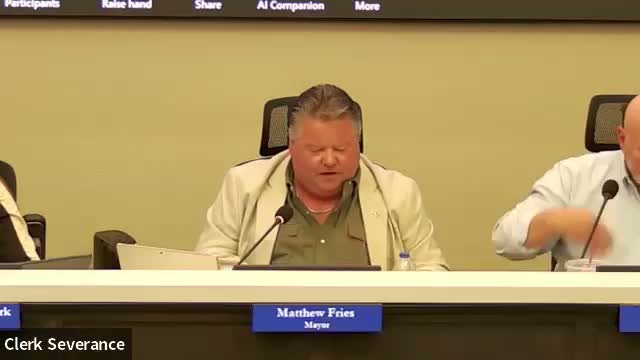
The council passed Ordinance 2026-02 by roll call vote. Mayor Friess and council members supported adoption so the town remains eligible for state and federal funding and can avoid the administrative penalty of being viewed as noncompliant.
The ordinance takes effect per charter timelines: the town’s charter provides a 30-day effective period before local implementation, and the code’s statewide effective date is currently July 1. Staff told the council they will return with follow-up details on training for inspectors, enforcement responsibilities, and public outreach to affected property owners.