Get Full Government Meeting Transcripts, Videos, & Alerts Forever!
Get email alerts on the Stormwater Landscape topic
No spam. Unsubscribe anytime.
Staff propose limiting rock mulch in detention ponds, move standards to stormwater manual
Summary
City planning staff proposed a temporary text amendment to remove ambiguous 'mulching' language from the land development code, default to vegetative plantings for detention facilities, and allow rock mulch only in narrow, site-constrained cases while the stormwater manual (SWIM) is updated; commissioners raised maintenance and cost concerns.
City planning staff presented a proposed temporary text amendment that would remove specific detention-pond landscaping rules from the land development code and instead reference the city’s stormwater manual, commonly called the SWIM, at a Planning Commission workshop.
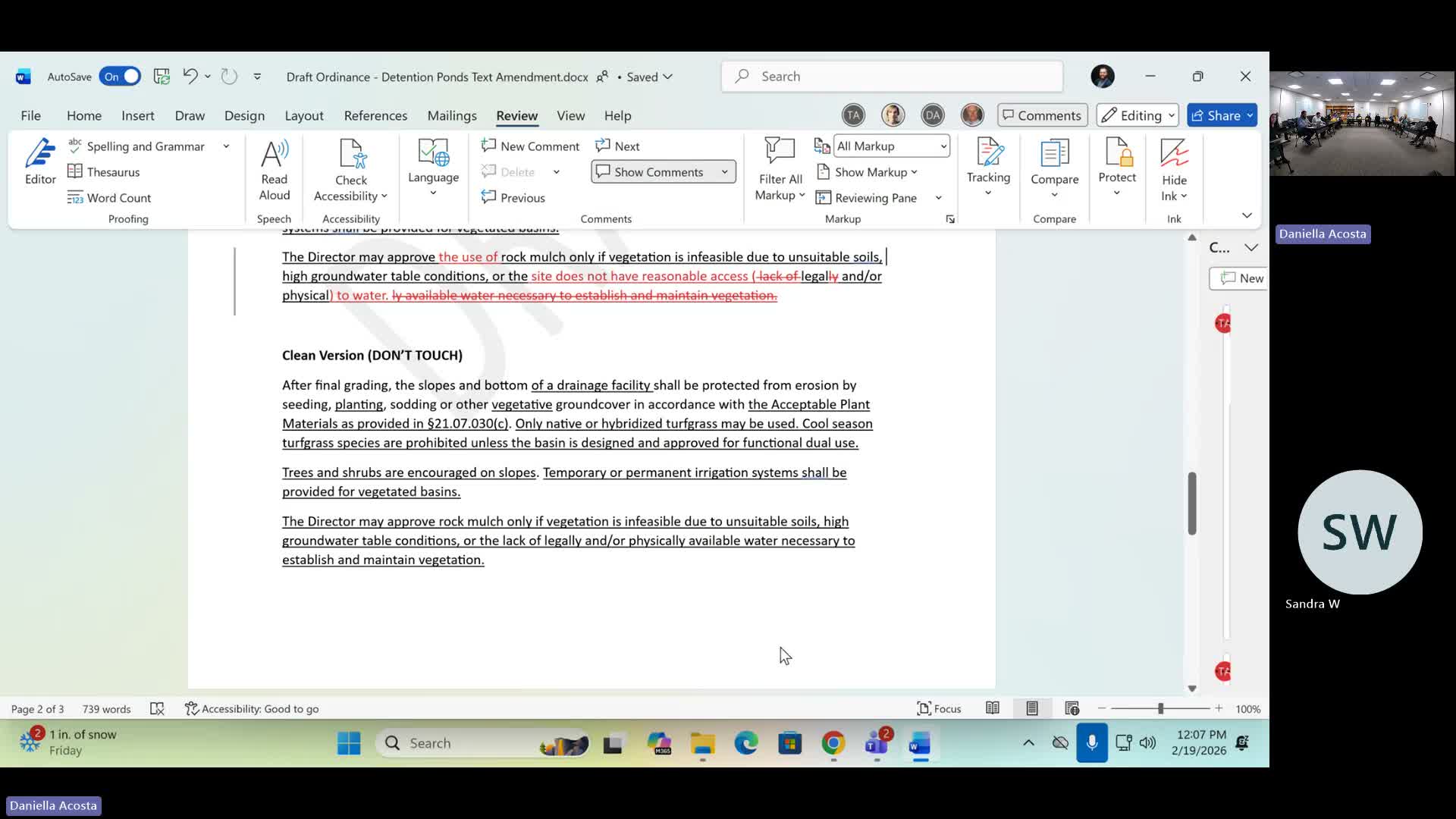
Daniella (staff member) told commissioners the SWIM is undergoing updates and that the text amendment is intended as an interim cleanup to remove a long-standing loophole. "If you go to our definitions in the land development code, mulching also includes rock," Daniella said, arguing that the code’s current wording caused unintended allowances for rock in detention basins.
The amendment would shorten the terminology to "detention facility," introduce the term "planting" (to make vegetative landscaping explicit), and make vegetative landscaping the default. Staff said the proposal would keep narrow exceptions for rock mulch where sites are constrained by unsuitable soils, a high groundwater table, or where legal or physical access to irrigate or maintain plantings is infeasible. Daniella said the SWIM update is expected to be adopted in July and staff targeted March 24 for a Planning Commission hearing on the amendment.
Commissioners and other panelists focused their questions on two trade-offs: water quality benefits and long-term maintenance costs. A staff speaker argued for vegetation’s environmental effect, saying, "plants are much better at removing pollutants and filtering them out." Several commissioners countered that establishing vegetated basins can require irrigation and repeated reseeding after major storms, and that maintenance costs are often borne by homeowners associations once stormwater permits are transferred.
One commissioner described the cost difference this way: "Any turf compared to rock, the rock, you just have to pay for weed spray," and warned that more irrigated or turf-based designs could raise HOA dues over time.
Staff acknowledged those concerns and emphasized the amendment’s intent to provide flexibility until the SWIM spells out acceptable plant species and design details. They also noted that construction stormwater permits and annual inspections would continue to govern final stabilization and sediment-removal requirements regardless of surface material.
The commission did not vote at the workshop. Staff said they would return the proposed text amendment, with minor language tweaks informed by today’s discussion, for formal consideration at a Planning Commission hearing scheduled for March 24.
Ending: The item will move to a public hearing; staff encouraged commissioners to continue deliberations at that meeting and to raise any additional language changes at that time.