Get email alerts on the Climate Commitment Act topic
No spam. Unsubscribe anytime.
City administrator warns Climate Commitment Act will raise costs for Enumclaw’s municipal gas utility
Summary
City Administrator Chris Searcy told the Enumclaw City Council that the state’s Climate Commitment Act (CCA) has pulled the city’s municipal gas utility into a cap‑and‑invest program, producing a new compliance charge on bills and uncertain future costs; staff recommended council consider policy options, funding strategies and possible collaboration with other municipal utilities.
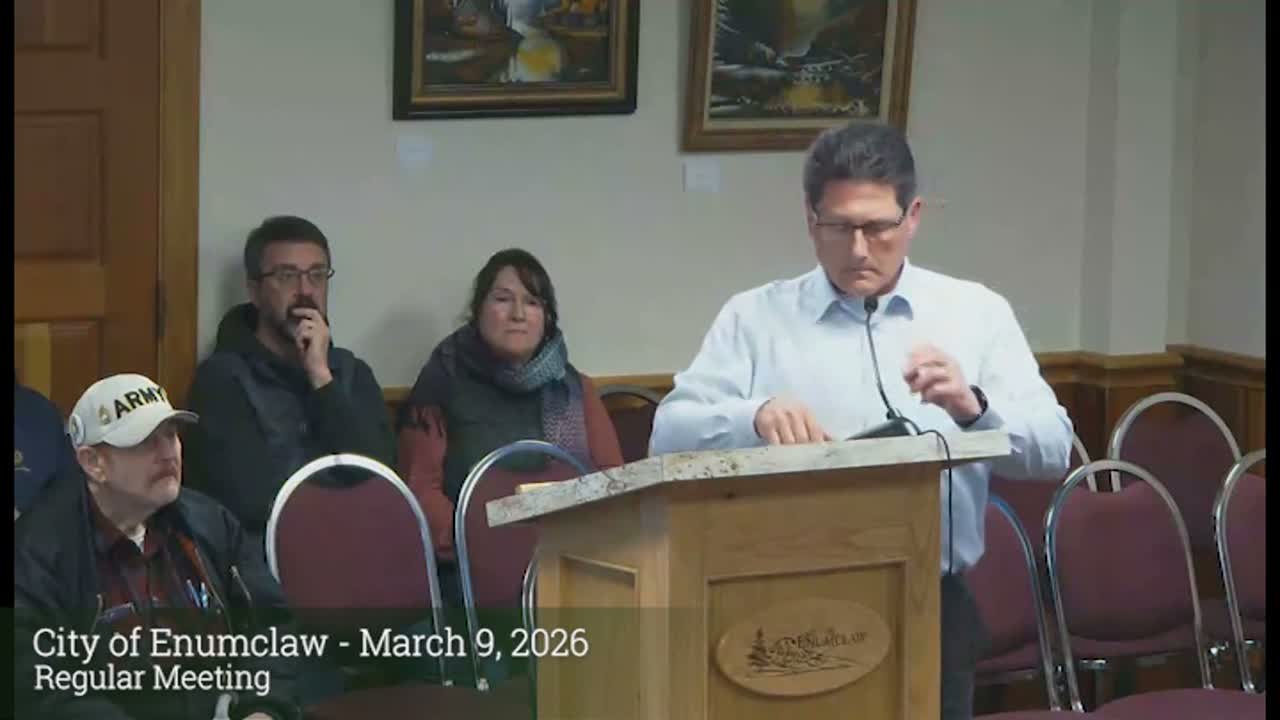
Enumclaw City Administrator Chris Searcy told the City Council on March 9 that Washington’s Climate Commitment Act is now affecting the city’s municipal gas utility and that the policy will create ongoing compliance costs the city must manage.
"It is the law. We must comply with it," Searcy said while outlining how the CCA’s cap‑and‑invest structure requires covered entities to obtain carbon allowances and how the program’s no‑cost allowances and auction proceeds are used. He said Enumclaw’s average emissions from 2023 through 2025 were just over the 25,000‑metric‑ton threshold that defines covered entities, and that the city could return to the program in future compliance periods if it remains close to the threshold.
Searcy explained two customer classes created under the rules: legacy customers (connected before July 25, 2021) and non‑legacy customers (connected after that date). Legacy customers benefit from the city’s ability to consign some allowances to auction and use proceeds to offset bill impacts, while non‑legacy customers bear a larger per‑unit compliance charge. "About 98% of the customer base is legacy," he said, adding that the initial CCA charge for legacy customers has been in the single‑digit cents per 100 cubic feet range while new customers have faced much higher per‑unit impacts.
Searcy summarized the scales of cost his staff has tracked: "The first year was about $250,000 in 2023," he said, and noted the city’s net CCA cost grew into the mid‑hundreds of thousands in later years; he warned that, depending on carbon prices and market linkage, compliance costs could ultimately exceed $1 million annually.
The presentation emphasized substantial uncertainty. Staff cited delays and litigation around the state’s greenhouse‑gas reporting, a potential future linkage between Washington’s market and California’s (and Quebec’s) cap‑and‑trade program, and ongoing court challenges to Initiative 2066 (a voter measure about access to natural gas). Searcy said Ecology progressively reduces no‑cost allowances and increases the share of allowances that must be consigned to auction over time, which raises net purchase obligations for covered entities.
Searcy described possible policy responses for council consideration: seeking an "alternative compliance" approach with other municipal gas utilities; pursuing state legislative changes to allow municipal utilities different treatment (for example, restricted accounts or dedicated decarbonization funds rather than full auction participation); pursuing grant funding for decarbonization planning; or adopting local cost‑recovery policies for new development.
Staff also flagged resource needs. Searcy said the city has managed initial reporting and allowance acquisitions with existing staff, but any program to reduce city gas load or assist customers in converting to electric heat pumps would likely require dedicated personnel and technical support.
Councilmembers asked for clearer projections and scenarios. Searcy said staff would return with refined year‑by‑year cost projections and described next steps: staff will gather additional data, check for alignment with Ellensburg (another municipal utility pursuing alternative compliance concepts), and return to the council for policy guidance in May or later this year.
No council decision was required that night; the council voted to continue discussion at a future meeting.
AI generated
The text on this page is AI generated. Summaries, highlights, analysis, and video transcripts are all produced from the original source material.
AI can make mistakes, so if you spot one, and we will fix it for everyone.
Note: the source content is unaltered by us. Any content source we link to, be it a video, an audio recording, or a document, is presented exactly as its publisher released it. That publisher is usually a government body, sometimes an individual official or another organisation.