Get Full Government Meeting Transcripts, Videos, & Alerts Forever!
Get email alerts on the Utilities Rate Setting topic
No spam. Unsubscribe anytime.
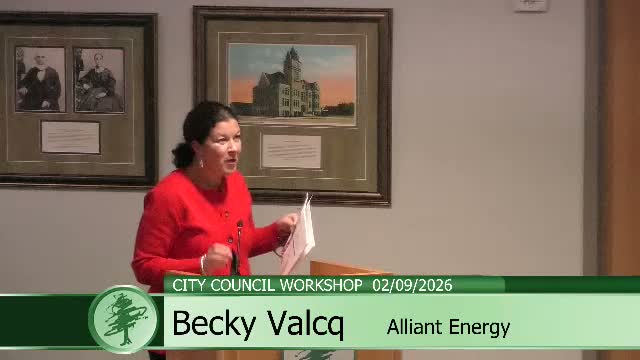
Alliant Energy official Becky Vock tells Janesville council data centers do not automatically raise local electricity rates
Summary
At a Janesville City Council workshop, Alliant Energy’s Becky Vock explained how regional dispatch and state rate-setting work, said utilities seek contracts to protect customers when serving large data-center loads and cited studies showing data centers do not inherently drive residential rates sky-high.
Becky Vock, an executive with Alliant Energy who identified herself as president of the company’s Wisconsin Energy Group, told the Janesville City Council on Monday that large data centers do not automatically push residential electricity rates higher.
"I am Becky Vock with Alliant Energy," Vock said in opening remarks, then summarized how generation, transmission and regional dispatch by MISO (the Midcontinent Independent System Operator) determine where electricity flows and how prices are set. She said Alliant is legally obligated to serve customers who locate in its territory and described the role of the Public Service Commission of Wisconsin in auditing utilities and approving rate changes.
The presentation focused on three points the utility said matter for local decision-making: who controls which resources are dispatched across the region; how the state Public Service Commission oversees allowable utility revenue and the allocation of that revenue across customer classes; and how utilities secure payment for infrastructure built specifically to serve large customers.
Vock described MISO as a regional operator that dispatches generation from many states to meet demand where it is needed, saying that plants are called on based on cost, not municipal boundaries. "We can't tell the electrons where to go," she said, explaining that generation sited in Wisconsin can be dispatched outside the state if regional needs and pricing warrant it.
On rate-setting, Vock said utilities file forward-looking rate cases with the commission and that the commission both audits costs and then approves the revenue level; allocation of that revenue among residential, commercial and industrial classes is part of the same public process. She noted utilities also must carry reserve margins to preserve reliability, and those reliability requirements factor into cost and rate calculations.
Addressing concerns that data centers cause sharp local rate increases, Vock cited independent research and Alliant materials posted online. "It's actually not true," she said of the claim that states with data centers always see electricity prices "go through the roof," pointing the council to studies from Lawrence Berkeley National Laboratory and an analysis by Charles River Associates.
Council members asked how rates would change if a data center located in Janesville. Vice President Squire asked whether an individual customer’s physical location within Alliant's service territory changes the allocation of costs. Vock answered that rates are set and allocated within the utility’s state-regulated service territory and that the effect is not limited to a 30-mile radius around a new customer: "It impacts all end users within your service area," she said.
When asked whether the utility would absorb the cost of new infrastructure such as a substation, Vock said Alliant’s approach in current negotiations is to require the end user to pay for upgrades that are specific to serving that customer. "If that substation isn't necessary to serve the rest of our customers, we will charge the cost of that substation to the data center customer," she said, adding that contracts include financial protections such as letters of credit to guard ratepayers if a large customer closes early.
A council member raised concerns about potential bias given that some utility executives previously served on the Public Service Commission; Vock confirmed she had worked at the commission earlier in her career and said her long tenure in the industry informed her perspective.
The workshop concluded after a brief question-and-answer period. Council member Williams moved to adjourn; Council member Nino seconded, Williams said "Aye," and the meeting was declared adjourned.
Next steps: staff said the workshop is the first in a series on data centers and that future sessions will address additional technical and rate-related subjects the council may wish to consider.