Get Full Government Meeting Transcripts, Videos, & Alerts Forever!
Get email alerts on the Planned Development topic
No spam. Unsubscribe anytime.
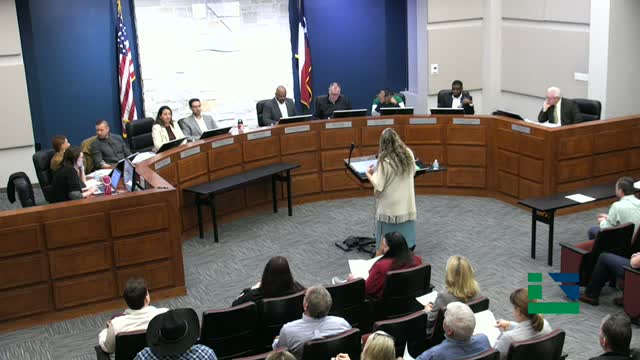
Little Elm council approves planned development for Whiskey Blendery after debate over neighbors' concerns
Summary
At its first 2026 meeting the Little Elm Town Council approved Ordinance 18‑35 to create a planned development for the Whiskey Blendery and passed a development agreement. Council kept an enclosure requirement for the second‑floor patio but did not incorporate an 8‑foot masonry wall or the 9:30 p.m. hours cap into the ordinance text as presented.
At its first meeting of 2026 the Little Elm Town Council voted unanimously to adopt Ordinance 18‑35, establishing a planned development district that will allow the Whiskey Blendery to relocate and build a multi‑building whiskey facility in the town's Lakefront District.
Planning staff told the council the rezoning applies to roughly 2 acres southeast of Eldorado and Hartwick and would permit a set of connected uses — office and administrative space, private meeting and cigar lounge areas, barrel storage and a customer‑experience/tasting building — with modifications to parking, screening and signage standards. Olga, the planning presenter, said the proposal seeks some waivers, including a request to waive approximately $52,000 in tree‑mitigation fees tied to proposed removals.
The issue drew dozens of public speakers at a packed hearing. Neil Blaze, president of the Little Elm Economic Development Corporation, urged approval and defended the EDC's role in recruiting unique businesses to the lakefront. "This project meets the council‑approved Lakefront District plan," Blaze said, urging council to accept the planning commission's recommendation. Several residents and nonprofit leaders — including Janette Espinosa, Little Elm's economic development director, and Jason Hernandez of La Tiendita — spoke in favor, stressing jobs, tourism and charitable partnerships.
Opposition focused on location and safety. Dina, speaking for an organized neighborhood group, said residents had tried repeatedly to get licensing and safety information and signaled plans to pursue a Texas Alcoholic Beverage Commission protest; she told the council the group had raised concerns about large‑scale barrel storage and said they were preparing a formal protest of licensing paperwork. "We have reached out to the ATF and the county for guidance and requested help to oversee the proposed storage of 50,000 gallons of flammable liquid," Dina said, noting residents felt they were not getting timely answers from the city.
Applicant Tim, who will operate the Blendery, responded that the operation is "not a bar" but a small‑scale, membership‑centered distillery focused on education and controlled, low‑volume visits. "This distillery is not a bar. It's not about a nightlife venue... it's a small scale operation centered on craftsmanship, education, memorable whiskey experiences," Tim said, and added that production, storage and fire‑safety systems would be designed to meet or exceed applicable codes.
Planning & Zoning had recommended approval 6–1 with conditions including an 8‑foot masonry wall along the residential boundary, a recommended 9:30 p.m. hours cap and an enclosed second‑floor patio to limit visibility into backyards. On final action the council approved the ordinance as presented while expressly directing that the second‑floor patio be enclosed to limit visibility; council members declined to incorporate the masonry‑wall requirement into the ordinance text on the floor and left hours enforcement to standard code/TABC processes and the development agreement. The development agreement that captures detailed site plans and commitments passed immediately afterward.
The ordinance and the DA passed by voice vote with all members present voting in favor. Next steps for the project include the applicant's submittal of site development and building permits, and any state licensing or TABC actions required for off‑premise sales or other alcohol‑related permits.
The public record for the item includes two planning‑commission hearings and extended public comment; several residents requested clearer tree‑mitigation accounting and explicit development‑agreement language to prevent assignment of PD rights without council approval. The council did not set a new hearing; staff said the development agreement and building/permitting reviews will follow standard review timelines.