Get Full Government Meeting Transcripts, Videos, & Alerts Forever!
Get email alerts on the Parking Enforcement topic
No spam. Unsubscribe anytime.
Rosenberg council debates stricter rules for long-term street parking after resident complaint
Summary
A resident urged action after years of abandoned vehicles in front of her home; council reviewed proposed ordinance changes including insurance requirements, limits on antique-plate protections, and whether to favor tickets or towing, and directed staff to draft enforceable language.
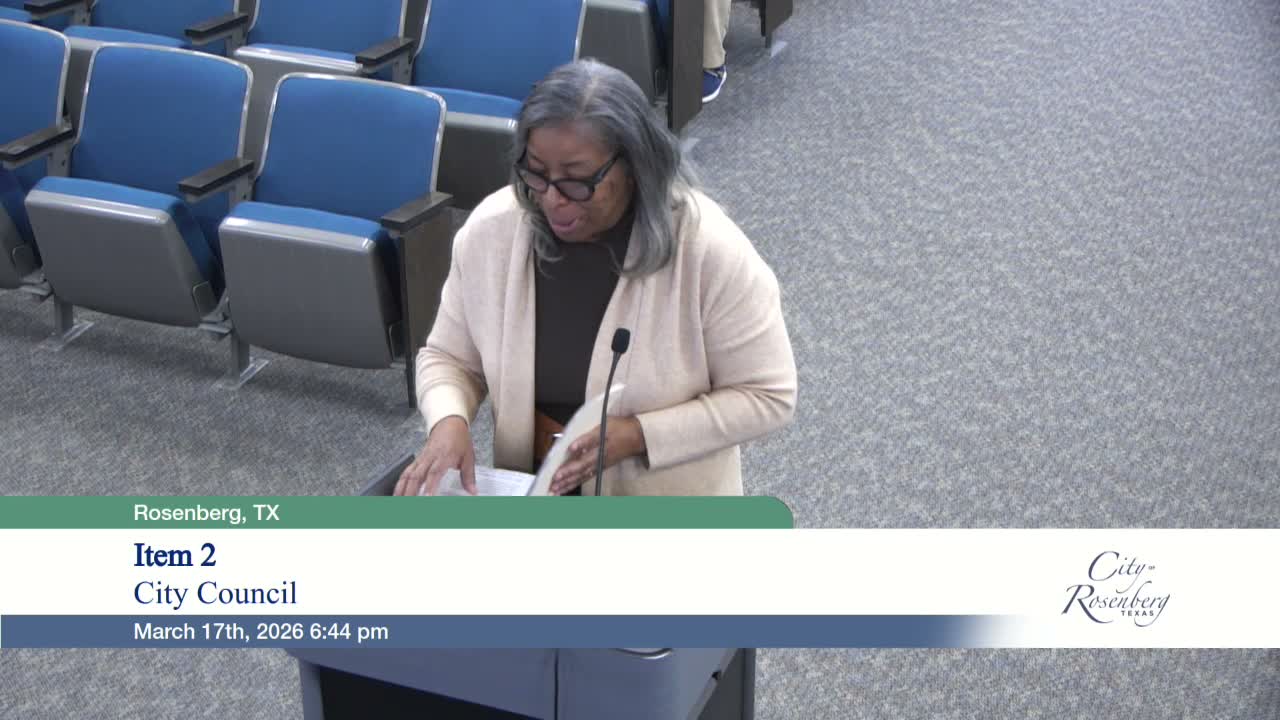
A Wilson Drive resident told the Rosenberg City Council that multiple old vehicles had sat on her block for years, blocking parking and lowering neighborhood appearance, and urged the city to enforce its ordinances.
Police Chief White explained current ordinance limits, including a 48-hour rule for remaining in one location and exemptions for certain registration types such as antique plates. He and staff outlined suggested amendments that would require proof of insurance for vehicles parked on public streets, exclude or redefine antique-plate protections, and allow vehicles out of compliance to be towed at the owner’s expense after a warning.
Councilmembers questioned how officers would determine whether a vehicle had been moved (a few feet vs. an actual relocation), whether a ‘‘regular commuting’’ definition would be enforceable, and whether towing created constitutional seizure risks. City Attorney counsel warned that vague standards could invite legal challenges and recommended objective, administrable measures (hours or days) instead of subjective tests.
Several councilmembers favored codifying an insurance requirement for vehicles parked on city streets; others argued for administrative citations or tickets rather than immediate towing to avoid tying officers to protracted enforcement tasks. Chief White noted practical hurdles: tickets generally require an identifiable violator, and many chronic-parked vehicles are not operated by the registered owner or have been moved a few feet to reset time limits.
Mayor moved to strike proposed language requiring ‘‘regular or consistent commuting’’ as too vague and to approve drafting the insurance and towing provisions (with warning) into ordinance language; that motion was seconded as recorded. Council directed the chief, the city attorney, and staff to meet with the resident to review the practical details and return with a draft ordinance for future consideration.
The council did not adopt a final ordinance at the meeting; it asked staff to prepare clearer, objective enforcement options for a future agenda.