Get Full Government Meeting Transcripts, Videos, & Alerts Forever!
Get email alerts on the Downtown Service Team topic
No spam. Unsubscribe anytime.
DDA proposes downtown service‑team pilot; council weighs faster vendor contract vs. in‑house public works model
Summary
The Downtown Development Authority presented two pilot options to provide downtown maintenance and service: a faster turnkey vendor (Block by Block) at about $834,000 and ~4 months to launch, or an in‑house Public Works model at about $930,000 requiring ~12 months to stand up; councilors debated labor, timing and interim 'blitz' cleanups.
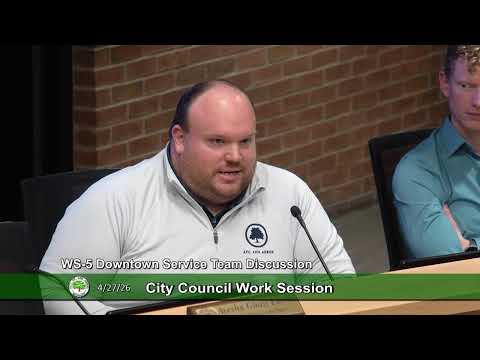
Maura Thompson, presenting for the Downtown Development Authority (DDA), asked council for guidance on piloting a DDA‑funded downtown service team. The pilot would consolidate sidewalk and small maintenance work and expand a service role (cleaning, landscape maintenance, bollard operation, snow clearing) with two delivery options: contract with Block by Block (a turnkey vendor) or run the pilot with Public Works staff under DDA funding.
Thompson summarized the tradeoffs: Block by Block’s turnkey model could deliver about 17,000 hours of service for an estimated $834,000 and start in roughly four months; a Public Works model would translate to about 14,000 hours, cost roughly $930,000 and take about 12 months to implement due to job description development, AFSCME review and recruiting. Thompson said both options would include dedicated supervisors, workforce development elements, and ongoing engagement with AFSCME around job descriptions and transition planning.
Council members voiced strong support for an in‑house model to secure union jobs and keep taxpayer dollars inside city employment; others favored a faster vendor launch to deliver near‑term improvements and to use a 12‑month vendor contract explicitly designed to transfer knowledge and roles into an eventual public model. Several members proposed using short‑term blitzes to address immediate downtown cleanliness while the longer implementation work proceeds.
Cost, hiring practice (how a vendor would recruit), timeline certainty, and whether blitz overtime should be budgeted separately were recurring questions. Thompson said block by block has committed to language that would not oppose union organizing, and staff committed to continuing AFSCME engagement and planning for a possible in‑house transition after a pilot year.
Council did not make a final selection during the work session; staff will return with additional implementation details and costings and with options for interim cleanliness efforts.