Get AI Briefings, Transcripts & Alerts on Local & National Government Meetings — Forever.
Colleton County school board shown scenarios to close $1.4 million 2026–27 budget gap
Loading...
Summary
At a board budget work session, district leaders said declining enrollment and state funding changes leave the district with an estimated $1.4 million shortfall for 2026–27 and presented scenarios — including staffing changes and program consolidations — that could yield roughly $1.8 million in savings.
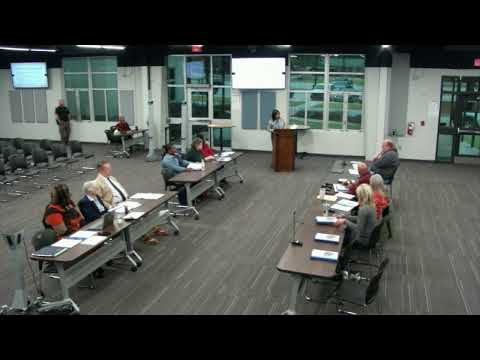
Superintendent Williams told the Colleton County School Board at a budget work session that the district faces a projected $1.4 million shortfall for the 2026–27 school year and presented multiple staffing and program scenarios to narrow that gap.
The presentation, led by Superintendent Williams and finance staff Miss Barrett, traced the shortfall to three main factors: a roughly $2.1 million withdrawal from the fund balance to cover FY25–26 commitments, a projected county millage increase that fell short of earlier expectations, and declines in average daily membership (ADM) that reduced state revenue. "We withdrew about $2,100,000 from the fund balance," Williams said, summarizing prior budget actions that shaped the district's starting point.
Barrett, who reviewed state revenue projections and formulas, said the district's FY27 revenue projection is based on the 45-day ADM and on weighted pupil units that allocate additional funding for students with greater needs. "The key takeaway is the average daily membership is the foundation and funding starts with student counts," Barrett said. She told board members the House Ways and Means projection the district used put FY27 revenue at about $57.1 million and said state changes reduced the district's net support by roughly $1.3 million across several lines.
Barrett also explained a required state minimum teacher salary increase and how the state will share the cost: "Every salary has to be increased this year… the state gives us 75% of that $2,000, and then we have to pay from our local fund 25% of that $2,000," she said. The presentation cited a district-wide loss in state aid related to enrollment changes and a reallocation of some health insurance funding into the state aid formula, which creates vulnerability to ADM declines.
District staff said attrition and fund reassignments have already produced savings: Williams and Barrett described roughly $1.8 million of savings through attrition decisions and reallocating certain positions to federal or EIA (CTE) funds. Even after those savings, Barrett summarized the remaining gap: "We are $1,400,000 short from balancing our budget." Board members repeatedly asked for the exact 45-day ADM count and for breakout numbers showing how many certified staff would be affected because those counts determine how many positions could be reduced without violating accreditation or staffing rules.
To respond to the deficit, staff presented six scenarios with illustrative bottom-line savings: Scenario A (move schools' teaching staff to state teacher-to-student ratios) estimated savings of about $754,776; Scenario B (adjust CCMS and CCHS to state ratios) $310,000; Scenario C (high school adjustments only) $177,000; Scenario D (apply state administrative ratios for assistant principals) $559,000 (board members noted reconfiguration of sixth grade could change which schools meet the threshold for APs); Scenario E (across-the-board 5% salary reductions at various levels plus a 10% reduction in material/supplies budgets) produced district-level illustrative savings (examples given: $138,000 at district-level salaries, $65,000 for principals, $62,000 for assistant principals); Scenario F (program and position consolidations/reallocations) showed potential of roughly $1,000,000 depending on which programs and positions are moved or eliminated.
Miss Hamilton, presenting school allocation worksheets, walked the board through grade-level FTE needs and recommended, for example, reallocating one FTE from second to first grade at Bells and using TA support where possible as a lower-cost alternative to hiring. Board members asked staff to update allocation charts to reflect projected sixth-grade moves and to provide consolidated totals and more precise ADM counts before the next meeting.
Superintendent Williams said the materials were intended to inform a policy and budget path forward rather than to produce immediate votes: board members were asked to review binders and return guidance so staff can prepare the first reading of draft one on April 21. "Tonight was just to present the information to you… We need to kind of know that as soon as possible," Williams said.
The session concluded without formal votes on any of the scenarios; Chair Nixon entertained a motion to adjourn, which was moved, seconded and the meeting ended.
Next steps: staff will provide updated 45-day ADM figures, a version of the staffing/allocation charts that reflects sixth-grade moves, and recommendations on which scenarios staff favors ahead of the April 21 first reading.