Get Full Government Meeting Transcripts, Videos, & Alerts Forever!
Get email alerts on the Environment Monitoring topic
No spam. Unsubscribe anytime.
Presenter describes continuous plutonium, americium and uranium monitoring at Woman Creek Point of Compliance
Summary
At the Woman Creek Point of Compliance (WOMPoc) at Rocky Flats, a presenter described continuous, flow-paced automatic sampling that monitors plutonium, americium and uranium; staff said measured concentrations remain well below soil and surface-water action levels and that backup samplers and telemetry protect sample continuity during floods.
At the Woman Creek Point of Compliance (WOMPoc) at Rocky Flats, a presenter described how automated, flow‑paced samplers run continuously to monitor plutonium, americium and uranium in surface water.
The presenter said, "We monitor for plutonium, Americium, and Uranium" and explained that the samplers operate "always on, always running 24/7, 365 or 366," collecting aliquots based on a pacing tied to flow so that higher flows produce more frequent samples.
The nut graf: This sampling design, the presenter said, gives more representative data across weather and runoff conditions than periodic manual bottle collection and helps detect radionuclide transport tied to either dissolved groundwater (in the case of uranium) or particle‑bound movement (in the case of plutonium and americium). The presenter noted that measured activities at WOMPoc "have all been well below our standards."
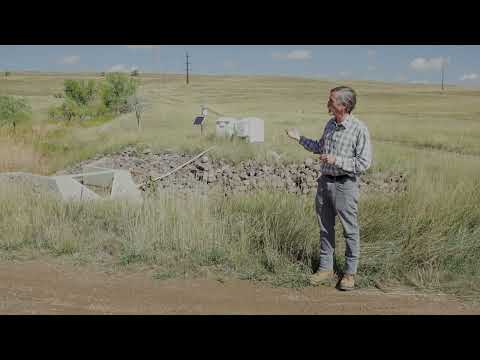
According to the presenter, the station combines flow from Woman Creek and Pond C2 upstream of the sampling flume; Pond C2's earthen dam has piezometers to monitor water levels. The sampling equipment includes two automated sampler boxes and a small precipitation gauge; sample bottles are 40‑liter carboys. Staff use telemetry to monitor sampler status and carboy fill remotely so they can schedule field visits only when needed.
The presenter described a flood contingency set up after a 2013 event that constrained access. To avoid missed data when a primary sampler fills during extreme flow, a second sampler is installed and programmed at a different pacing (the presenter used hypothetical pacing examples of one sample every 2,000 gallons versus one every 10,000 gallons) so it will continue to collect during prolonged high flows.
On environmental behavior and standards, the presenter said plutonium and americium tend to move attached to silts and clays and therefore mobilize during heavy runoff, whereas "uranium can be present dissolved in the surface water and dissolved in groundwater." The presenter stated residual low-level plutonium contamination remains east and southeast of the former 903 Pad at about "a picocuries per gram or 2 picocuries per gram." The soil cleanup target mentioned was "50 picocuries per gram." For surface water, the presenter cited a plutonium standard of "0.15 picocuries per liter" and said the uranium threshold is "16.8 micrograms per liter," adding that current sample activities at WOMPoc are far below those values.
The presenter also noted the station is effectively off the grid, powered by sampler batteries recharged by solar panels despite a nearby high-voltage transmission line, and pointed out downstream features including the Woman Creek Reservoir (the Stanley Lake Protection Project) and Stanley Lake, which the reservoir is designed to bypass.
The presentation concluded with an operational note: remote telemetry and staggered pacing, together with the second sampler, reduce the chance of missed samples during extreme weather and help maintain the statistical confidence of annual sampling plans. The presenter said staff continue routine monitoring and have not reported exceedances at WOMPoc.