Get AI Briefings, Transcripts & Alerts on Local & National Government Meetings — Forever.
Committee hears push to eliminate cash bail; members warn services, public‑safety details needed
Loading...
Summary
At an April 28 informational hearing, Vice Chair Hollins and testifiers urged a constitutional amendment to eliminate cash bail and create a presumption of pretrial release; prosecutors and some legislators said statutory details, funding and mental‑health capacity must be resolved before making the change.
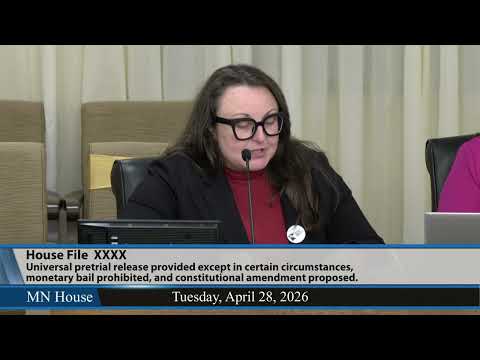
Vice Chair Hollins introduced a proposed constitutional amendment at an April 28 Rules and Legislative Administration Committee hearing that would eliminate monetary cash bail and establish a presumption of pretrial release, saying the change would prevent wealth from determining pretrial liberty and allow courts to detain only those who pose a clear risk to others or to the integrity of the judicial process.
Joshua Page, a professor of sociology, law and public affairs at the University of Minnesota and co‑lead of a state pretrial study, told the committee research shows "about 56% of people in Minnesota jails are held pretrial" and that Black and American Indian Minnesotans are overrepresented in that population. Page said the research and examples from other states show monetary bail does not increase court appearance rates or improve public safety and that the amendment is needed to enable a statutory "intentional release and detention" system the legislature would later design.
Alicia Gransey, a staff attorney at the ACLU of Minnesota and a former public defender, argued cash bail undercuts the presumption of innocence and equal treatment under the law. "The time has come to eliminate cash bail in Minnesota," Gransey said, urging individualized judicial determinations based on evidence that a person poses a safety or flight risk. She told the committee the Minnesota Constitution currently guarantees a right to bail (Article I, Section 7) and cited State v. Ladue (2009) in explaining why advocates believe a constitutional amendment is necessary rather than statutory change alone. Gransey also cited national figures, saying the annual national cost of pretrial detention is about $13,600,000,000 while noting Minnesota's total cost is "not specified" because of data gaps.
Jess Palliant, policy program manager for Violence Free Minnesota, focused on survivors of domestic violence and the way first‑appearance hearings are conducted. Palliant said observers reviewed roughly 800 first‑appearance hearings and found "over 75% of those hearings for bail lasted less than 10 minutes" and that victim input was raised in fewer than 15% of the hearings. She said the amendment would shift attention from a defendant's access to cash to public‑safety factors and would better recognize protection orders and victim safety in pretrial decisionmaking.
Ramsey County Attorney John Choi said he supports focusing pretrial decisions on public safety and return‑to‑court risk, and he urged careful, bipartisan drafting of the implementing statutes. Choi described pandemic‑era instances when people were released after posting bail and noted situations in which defendants were released because courts found them incompetent to stand trial; he said the legislature has created some statutory options but that fuller funding and local capacity are needed to make alternatives workable statewide.
Throughout the hour of questions and discussion, committee members pressed two consistent themes: whether eliminating monetary bail removes a useful, calibrated tool for many middle‑risk cases, and whether the state has the community services and supervision capacity to manage people released under a new system. Co‑chair Niska warned the amendment "eliminates a tool to secure the release" for the broad middle of cases and asked why calibrated financial security could not remain an option. Representative Scott described a local case of a person with mental‑health needs who was bailed out and later caused serious property damage, and he said he would not support a major change until there are places and services to receive people on release.
Proponents replied that a thoughtful statutory framework could preserve conditional release, expand pretrial services and connect people to treatment and supervision that courts can use in lieu of money. Page told the panel that in many systems 90% of people return to court and that court notifications, pretrial services and service referrals can achieve appearance rates without requiring cash bail.
The hearing was informational; no committee votes were taken. Chair Long closed by noting common ground on focusing on risk and return‑to‑court factors and by urging further work on statutory implementation. Vice Chair Hollins reiterated that the amendment would give voters the opportunity to modernize Minnesota's pretrial system.
The committee packet included the posted draft amendment (revision number referenced in the hearing), a one‑page coalition summary from Pretrial Justice Minnesota and a letter from advocates for human rights cited by witnesses.