Get Full Government Meeting Transcripts, Videos, & Alerts Forever!
Get email alerts on the Ccap Program Integrity topic
No spam. Unsubscribe anytime.
DCYF says it has ramped CCAP fraud controls as committee presses on Quality Learning Center stop payments
Summary
DCYF and its inspector general told a House committee they have increased oversight of the Child Care Assistance Program (CCAP), used stop-payment authority and opened an accelerated schedule of compliance visits; lawmakers pressed the agency about recent federal searches and a video alleging ongoing fraud at specific sites.
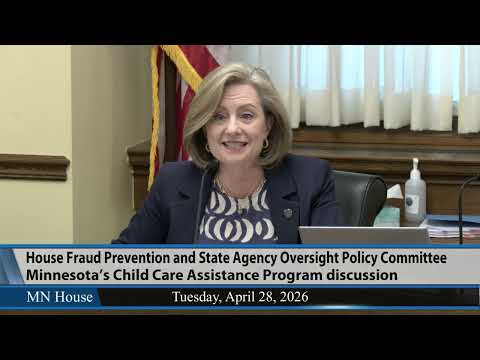
The House Fraud Prevention and State Agency Oversight Committee on Tuesday heard agency officials describe expanded efforts to detect and stop fraud in the Child Care Assistance Program (CCAP), including using stop-payment authority and increasing compliance visits.
"Today's actions put fraudsters on notice that Minnesota does not tolerate fraud in our public programs," Commissioner Tiki Brown said, describing DCYF's focus on program integrity and cooperation with the Bureau of Criminal Apprehension and federal partners.
Why it matters: CCAP provides subsidized child care to families statewide — Commissioner Brown said the program annually supports about 23,000 children from 12,000 families and that roughly 3,500 providers accept CCAP. Lawmakers pressed agency leaders to explain why relatively few matters have led to criminal prosecution since 2019 and to reconcile agency records with media footage and federal searches conducted this week.
Brown described structural reforms since 2019, including a statewide electronic attendance-records requirement, conditional certification for some centers, and expanded administrative sanctions. Randy Keyes, inspector general for DCYF, said his office has organized teams for outreach, data analytics, licensing and CCAP provider investigations, consolidated program data into a single data lake, and opened an accelerated series of compliance visits. "We are using all of the tools that we have available to us," Keyes said.
The committee focused on a recent site identified in news reports and subject to federal searches this week. Keyes told the committee that DCYF "imposed the limits on receiving public funds and stop payments to Quality Learning Center" on 12/30/2025 and that the center subsequently closed effective 01/06/2026; he added the agency did not revoke the license but did stop CCAP payments. The chair pointed out a apparent discrepancy between a video shown in committee and agency records on the closure date; Brown said the department's records reflected the information it had at the time and that some centers identified in the video had ongoing investigations but not agency findings of fraud.
Members also asked for more transparency about referrals to prosecutors. Keyes said DCYF refers cases to the BCA and county prosecutors when warranted but that decisions about criminal investigation priorities and prosecutions are made by law enforcement and prosecutors outside DCYF's control. He said criminal prosecutions in these matters generally go to county district attorneys unless a U.S. attorney becomes involved.
Committee chair and members requested follow-up documentation, including lists of employees who served on earlier investigation teams and records on referrals to county attorneys, to help resolve open questions about staffing, past suppression allegations and the low number of convictions cited by members.
What happens next: Committee members asked DCYF to provide personnel lists and referral records for follow-up. The committee did not vote on any policy changes during the hearing.
Sources: Testimony by Tiki Brown and Randy Keyes before the House Fraud Prevention and State Agency Oversight Committee. Commissioner Brown and Inspector General Keyes spoke directly about agency reforms, stop payments and ongoing investigative work during the hearing.