Get AI Briefings, Transcripts & Alerts on Local & National Government Meetings — Forever.
Tempe officials seek voter approval to add 0.4% public-safety sales tax and 0.1% transit tax to close budget gap
Loading...
Summary
City staff proposed two ballot measures — a 0.4% dedicated public-safety sales tax and a 0.1% transit sales tax — to replace revenue lost from recent state actions; council signaled consensus to prepare a call for election for April 30 and asked staff to expand outreach and brief commissions.
City staff told the Tempe City Council on Monday that two proposed local sales-tax increases — a 0.4 percentage-point tax dedicated to public safety and a 0.1 percentage-point tax for transit — would stabilize the city’s budget after recent state actions that reduced local revenue.
Deputy City Manager and CFO Lisette Camacho, presenting the fiscal year 2026–27 budget review, said the two measures would generate an estimated $40.3 million annually from the 0.4% public-safety tax and about $10.1 million annually from the 0.1% transit tax. "This proposal reflects the feedback from the 2025 community and business surveys," Camacho said, and would first offset an $18.1 million general-fund loss tied to state changes before funding police, fire, park rangers, inspections, and other safety-related capital and operating needs.
The proposed transit increase, Camacho said, would help maintain Valley Metro services, support a planned streetcar extension and multimodal improvements, and fund pedestrian and cycling connections. "This tax increase would generate about $10.1 million annually, and it would help offset approximately $6 million in transit revenue loss from the repeal of residential rental," she said.
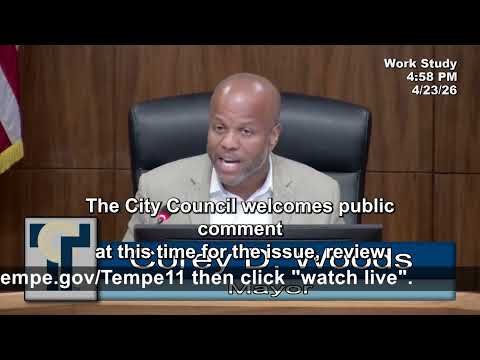
Mayor Corey Woods and council members repeatedly stressed that staff were not asking the council to adopt the measures tonight but rather to prepare materials for a potential call for election. The mayor summarized the direction: staff should prepare the resolution to be considered at the council’s April 30 meeting. Council members indicated no objection to moving the item to next week for formal action.
Several members pressed staff on alternatives and tradeoffs. Councilmember Hodge asked why the proposed levies would be permanent rather than temporary; Camacho explained the revenue lost when the state repealed the residential rental tax is effectively permanent unless the legislature acts to restore taxing authority. "Recessions are different than the revenue loss that we received from the loss of residential rental," she said, noting there is no mechanism for the city to recapture those dollars absent state action.
Other council members pushed staff to exhaust non-tax options and to describe service impacts if the measures do not pass. Camacho and budget director Robert Baer explained the general fund is roughly $341 million and that approximately 54% of that supports public safety; they also referenced roughly $12.4 million in midyear savings already implemented to limit short-term impacts. On the question of voting thresholds, staff said the measures would require a simple majority to pass.
Kelsey Files, a Tempe resident who spoke during public comment, said she supports expanding the transit tax but urged the council to brief the Transportation Commission before placing the question on the ballot. Councilmembers asked staff to make sure commissions and community outreach occur between now and any final council action.
Staff also noted accompanying financial-policy items that will come back to council, including consolidating the city's finance policies on June 25 and updating fund-balance rules for the ambulance and water/wastewater funds.
The council did not vote on the measures Monday; instead, members gave staff direction to prepare a resolution for next week’s meeting and asked for continued outreach and additional detail for commissioners and councilmembers. If voters approve both measures, Camacho said, Tempe’s local tax rate would rise from 1.8% to 2.3%, increasing the city tax on a $100 purchase by 50 cents.