Get Full Government Meeting Transcripts, Videos, & Alerts Forever!
Get email alerts on the Floor Votes Roundup topic
No spam. Unsubscribe anytime.
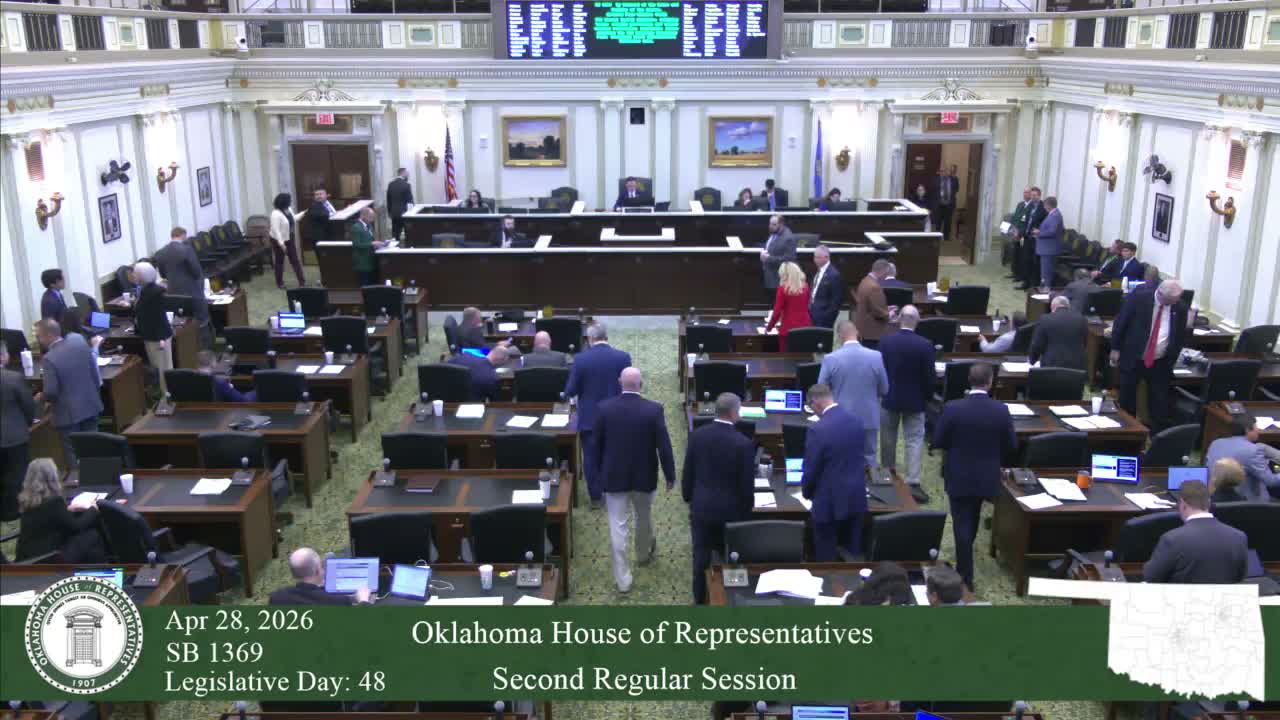
House approves 988 fund and several statutory updates, rejects county relocation assistance bill after extended questioning
Summary
The Oklahoma House advanced and passed measures including a 988 revolving fund to sustain the mental‑health lifeline and updates to THC and corrections‑monitoring statutes, but defeated Senate Bill 483, a county relocation assistance program, following extended floor questioning about oversight and safeguards.
The Oklahoma House of Representatives on the floor moved a package of measures on the first day of session, approving funding and statutory updates for behavioral‑health, criminal‑justice and administrative rules while rejecting one high‑profile bill that would have authorized county relocation assistance programs.
Representative Norwood presented Senate Bill 13 69, saying, “Senate bill 13 69 ensures Oklahoma's 988 mental health lifeline remains operational by creating a 988 revolving fund.” After no questions, the House advanced the bill and voted to pass it by a recorded tally of 85 ayes to 7 nays.
The bill’s backers said the revolving fund is intended to sustain Oklahoma’s statewide behavioral‑health response infrastructure for callers to the 988 line. The House moved quickly through several additional measures that drew little debate on the floor, including a drone‑penalty bill and changes tied to state administrative practice.
Representative West Josh described Senate Bill 14 41 as a public‑safety clarification: “This bill clarifies that knowingly flying a drone in the airspace of a designated, critical infrastructure and making contact … is subject to the same penalties incurred for physically making contact.” The House advanced and passed that measure on final passage.
A more contentious exchange occurred over Senate Bill 137, a mirror of earlier House language changing eligibility for the Department of Corrections’ electronic monitoring program. Representative Wilk defended the bill amid questions about retroactivity; Representative McCain asked whether the language would make the change retroactive, saying that could be “unconstitutional.” Wilk responded that the provision is administrative, not judicial, and that the attorney general’s office did not consider it unconstitutional. The House passed SB 137 by a recorded vote of 72 ayes to 18 nays.
The chamber spent extensive floor time on Senate Bill 483, introduced by Representative Curbs, which would have authorized county boards of commissioners to establish voluntary relocation assistance programs by public‑private partnership. Representative Curbs described the proposal as creating a statutory pathway for counties to partner with nonprofits or private entities to assist people who want to relocate to places with family or services.
Members pressed the author on multiple points: “Particularly, how will this be set up? Will it be set up as a county trust, as a public trust? Is there … potential that this will be subcontracted out or will this be a county‑run program?” asked Representative Decker. Representative Curbs answered that the bill contemplates public‑private partnerships and that counties could contract for services, but several members said the bill lacks explicit safeguards.
Representative Blansett noted local data from Tulsa: “In the recent point in time count for Tulsa, almost 85% of the people that were unhoused that were counted were from that local area,” and questioned the bill’s value if most people are local rather than transient. Other members worried about the absence of mechanisms to prevent the shuttling of people between jurisdictions, access to criminal‑records checks, and what would happen if a receiving party failed to follow through.
After debate and questions, SB 483 failed on final passage (vote recorded as 35 ayes, 52 nays). Representative Curbs said he would seek reconsideration on a future legislative date.
Later floor action included passage of Senate Bill 8 43 (changes to minimum ADA thresholds for certain school‑board hiring exemptions), an Administrative Procedures Act bill requiring agencies to publish guidance statements clarifying guidance lacks the force of law (unanimous passage), and legislation updating THC scheduling language to align with federal changes. Representative Turner described SB 12 57 as an update of statutory language related to THC and said federal rescheduling uncertainty was noted on the floor; the bill passed 68–13.
Representative Townley’s SB 13 65 on the Central Purchasing Act failed narrowly on final passage (43–42); Townley announced he would move to reconsider at a later date. The floor wrapped with member introductions, announcements and a recess until 1:15 p.m.
What’s next: Representative Curbs said he will seek reconsideration of SB 4 83. Several other bills that passed on third reading will move forward in the process according to the chamber’s calendar.