Get AI Briefings, Transcripts & Alerts on Local & National Government Meetings — Forever.
MnDOT offers WAV study recommendations; disability advocates and providers press for reimbursement and pilots
Loading...
Summary
MnDOT presented a study recommending county contracts, a potential TNC surcharge, higher reimbursement rates, fleet purchases and pilots to expand wheelchair-accessible vehicle (WAV) availability; disability advocates and providers urged reporting, pilots in Greater Minnesota, and sustainable funding.
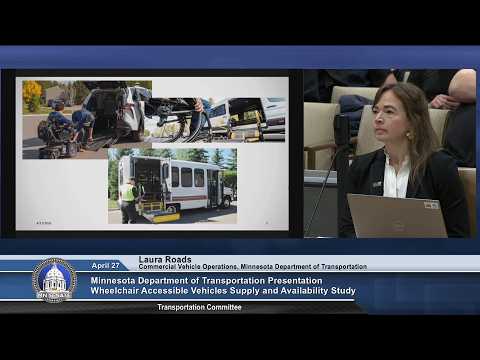
Laura Rhodes, director of MnDOT's Commercial Vehicle Operations section, and Sam Ritchie, staff attorney, summarized a legislatively directed study on wheelchair-accessible vehicle supply and availability and outlined recommendations for the Legislature.
"Access to safe, affordable and reliable transportation for all individuals is essential for Minnesotans' prosperity and quality of life," Rhodes said. The study—completed after stakeholder meetings, public surveys, and targeted outreach including at the state fair—identified three top user priorities: on-demand availability, reliable access to medical appointments, and increased rural options.
MnDOT’s recommended policy options include providing funding for counties to contract with WAV providers to create an on-demand premium service similar to Metro Mobility, imposing a surcharge on transportation network company (TNC) rides to create a reimbursement pool for WAV trips, purchasing and maintaining WAV fleets, increasing reimbursement rates for STS and NEMT providers, encouraging TNC pilot programs, and including accessibility language in connected and automated vehicle planning.
Joel Runnels of the Minnesota Council on Disability told the committee the recommendations align with what disability stakeholders have consistently requested, urging mandatory data reporting on WAV availability, wait times and service gaps; targeted pilot programs in the metro and Greater Minnesota; statewide guidance on service expectations; and exploration of sustainable funding.
Joan Wilshire offered lived-experience testimony about a three-hour delay after a snowstorm that left her without an accessible ride and urged the committee to adopt practical recommendations. An advocate who identified himself via committee invitation as Rob Budlick discussed prior bill language (S.F. 4699 and S.F. 1111) and said a per-ride surcharge of $0.15–$0.40 could expand WAV share of the TNC fleet by an estimated 2.5–10 percent, depending on the level.
Josh Berg, speaking from a human-services perspective, described a canceled WAV ride that stranded a client and argued the system consistently denies people access to medical appointments, employment, and social participation. "This is not a one off," he said. "Transportation is the thread that holds a person's life together."
Committee members thanked presenters and testifiers and asked follow-up questions about funding, pilots, and how appropriations for operations and maintenance are used. The panel did not take action; presenters and advocates said they would continue work with the Legislature over the summer to refine proposals.
The study and stakeholder letters are posted in the committee packet; MnDOT pointed members to a table in the report (pages 24–25) that outlines options and relative trade-offs.