Get AI Briefings, Transcripts & Alerts on Local & National Government Meetings — Forever.
Senate passes omnibus safety bill with courthouse grants, a protective-services unit and ban on selling marked emergency vehicles
Loading...
Summary
The Minnesota Senate passed SF3432 on April 27, 2026, a three-article public-safety package that funds courthouse security grants and legislative security, creates a protective services unit within state patrol for credentialed threats, and prohibits selling public-safety vehicles to the public unless identifying equipment is removed. Vote: 45–19.
The Minnesota Senate passed Senate File 3432 on April 27, 2026, approving a three-article safety and security package that includes courthouse security grants, operational adjustments for the judicial branch, dedicated funding for legislative security, and a new prohibition on selling public-safety vehicles to the public with identifying equipment still attached. The bill passed on third reading by a recorded vote of 45 ayes to 19 noes.
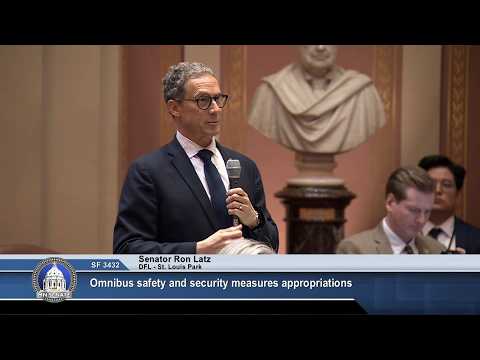
Senator Ron Latz, the chief sponsor of the courts portion, told colleagues the bill responds to rising threats against judges and court staff and provides grants and reimbursements to help local courthouses improve physical security. "Our judges should be able to make their decisions without fear," Latz said, citing survey results showing judges and their families have experienced threats and inappropriate communications.
The bill also includes measures supported by Senator Scott Dibble and Senator John Hoffman: physical-security upgrades at the Capitol Complex, expanded screening and staffing, a voluntary, budget‑neutral emergency contact system for officials, and a protective services unit hosted in capital security under state patrol oversight to provide executive protection when a credible threat is identified and requested in writing by legislative leaders. Dibble described the unit as able to provide both on-premise and off‑premise protection and to coordinate with local law enforcement.
Hoffman, one of the bill's proponents and an author of the vehicle-decommissioning language, said the provision is new and aims to prevent members of the public from acquiring former public-safety vehicles that still look like active emergency vehicles. "This is new language in this bill that would prohibit that," Hoffman said, recounting incidents in which decommissioned vehicles were used to impersonate officers.
Floor debate ranged from procedural questions and friendly edits to larger objections about scale and priorities. Senator Lucero successfully offered, and the body accepted, an oral amendment changing the prohibition's wording from "may not" to "must not" to clarify the ban on transfer without removal of identifying equipment. A separate A11 amendment, which sought to add equivalent school-safety funding to the bill, was ruled not germane by the presiding officer after a point of order; the body upheld that ruling on appeal by roll call.
Critics objected to the bill's size. Senator Jaskowski noted the package totals approximately $95 million per biennium and questioned whether the funds were concentrated appropriately; he said much of members' public-facing time is spent away from the Capitol. Supporters including Senators Matthews and Kroon urged passage, emphasizing the bill's investments in personnel and infrastructure for law enforcement, courthouses, and the functioning of the legislature.
The Senate recorded 45 ayes and 19 noes on final passage; the bill's title was agreed to and it will proceed according to the legislative process for enrollment and transmission.
What happens next: The bill, as passed by the Senate, will be enrolled and transmitted to the House and then to the governor for signature or further action per the legislative schedule.