Get Full Government Meeting Transcripts, Videos, & Alerts Forever!
Get email alerts on the Health System Update topic
No spam. Unsubscribe anytime.
County health leaders report capacity gains, higher ED visits, measles case and late RSV season; consultant warns of federal funding risks
Summary
Santa Clara Valley Health Care reported capacity gains (breast center expansion, O'Connor age‑friendly designation), rising emergency and inpatient use, and projected Medi‑Cal incentive funding; the county health officer reported a measles case and an unusually late RSV season. A policy briefing warned HR 1 and federal reconciliation could threaten county health funding.
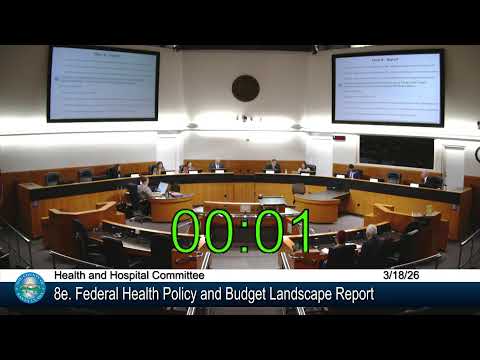
Santa Clara County health leaders updated the Health and Hospital Committee on system performance, public‑health alerts and budget risks to county health funding.
Paul Lorenz, identified in the meeting as Santa Clara Valley Health Care CEO, reported the South County Children’s Advocacy Center has broken ground and the Valley Medical Center breast center’s capacity expanded after adding a second surgeon, which the system said produced a 51% increase in visit volume. Systemwide emergency‑department visits and inpatient utilization were reported as rising (approximately 15% and 7% respectively since July 2025), reflecting sustained community reliance on county hospitals.
Lorenz also said the health system is on track to receive quality incentive (EQIP) funding estimated at about $170 million annually and described a recent certification that allowed pharmacist‑led diabetes education at Valley Health Center sites to become billable; that initiative generated about $750,000 in new revenue across four sites during a recent three‑month span, the presentation said.
The county public‑health officer briefed the committee on the county’s first measles case of the year and outlined prompt contact‑tracing and exposure‑management steps taken to prevent spread. The officer also warned of an unusually late RSV season and recommended pediatric and obstetric providers consider an additional monoclonal‑antibody prophylaxis window for infants born through April or infants who have not yet received prophylaxis.
A separate briefing from a state/federal policy consultant (introduced as Bert Magolin) reviewed the ongoing limited Department of Homeland Security staffing impacts, a contentious national debate over voting legislation, and the budget risk posed by HR 1 and federal reconciliation. The consultant said HR 1 has already reduced resources available to counties and described county and coalition asks to the state — including ending county self‑financing of the nonfederal share for inpatient fee‑for‑service care, boosting eligibility‑worker capacity, and requesting at least $2 billion in state funds to address increased indigent care costs.
During public comment, a Zoom speaker made urgent allegations about child abuse and urged the county to perform screenings; the speaker said they had also submitted written comment. No formal board action followed the public comment beyond the usual recording and referral to staff as appropriate.
What happens next: Health system staff said they will continue to publicize system achievements, return with follow‑ups on revenue and access metrics, and the public‑health office will continue surveillance and outreach related to measles and RSV. The county’s budget‑advocacy strategy on HR 1 impacts will proceed through state and coalition channels.