Get Full Government Meeting Transcripts, Videos, & Alerts Forever!
Get email alerts on the Municipal Budget topic
No spam. Unsubscribe anytime.
Council hearing flags rising debt service and limited reserve coverage in FY27 plan
Summary
Council members pressed finance on reserve policy and rising debt service in the administration's FY27 plan, citing that the city meets the GFOA two-month reserve recommendation only in FY25 and that tax-supported debt-service costs rise through FY27; officials said a large pension balloon payment later in the plan will reduce fixed costs.
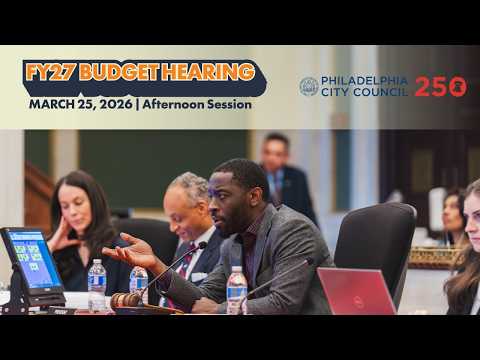
The Philadelphia City Council Committee of the Whole questioned administration finance officials on the city’s long-term fiscal outlook as they reviewed the proposed FY27 budget.
Council member Catherine Gilmore pressed the administration on the Government Finance Officers Association recommendation that general-purpose governments hold at least two months of unrestricted general-fund operating expenditures in reserves. "GFOA recommends at a minimum that general purpose governments maintain unrestricted budgetary fund balance in their general fund of no less than 2 months of fund operating expenditures," Gilmore said, asking whether the five-year plan meets that benchmark and what steps the administration will take to curb spending to avoid drawing down the fund balance.
A finance official acknowledged the city met the overall GFOA goal in FY2025 but said the five-year plan otherwise falls short. The official pointed to constrained operating growth and singled out rising benefits costs, a reinstated labor reserve and an expanding SEPTA subsidy as primary drivers of higher fixed costs, saying administration leaders have asked departments for 1–2% reductions rather than larger 5–10% scenarios used in past crises.
Gilmore also outlined the city’s rising tax-supported debt service and related fixed costs, citing an increase from roughly $159.7 million in FY19 to a proposed $241 million in FY27 and noting the tax-supported debt-service share of general-fund expenditures rising toward policy thresholds. She flagged the Water Fund’s higher projected debt burden (roughly $290 million budgeted for FY27) and asked how the city intends to manage that load amid global economic uncertainty and a large local population in need.
Finance officials said part of the budget’s structuring reflects an anticipated large pension "balloon" payment in FY29 and that, while tax-supported debt-service peaks in the near term, projected fixed costs should fall later in the plan as that payment is paid down. Officials committed to provide written follow-up on historical threshold exceedances and additional detail on options to reduce fixed costs over the five-year horizon.
Council members asked for additional written materials and for the administration to show when the city last exceeded internal thresholds and how the five-year plan would adjust if expected state enabling revenues or hotel-tax inflows do not materialize.
The committee recessed at the end of the hearing and will reconvene March 31, 2026 at 10:00 a.m.