Get Full Government Meeting Transcripts, Videos, & Alerts Forever!
Get email alerts on the Gilti Taxation topic
No spam. Unsubscribe anytime.
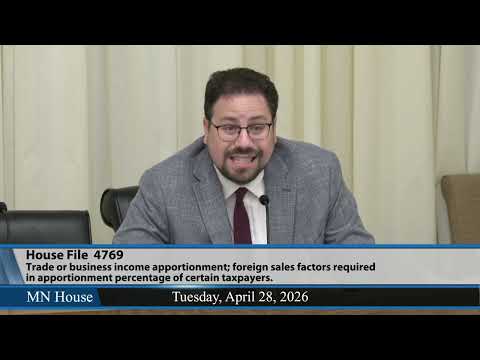
Committee hears bill to change Minnesota's GILTI taxation; Chamber warns of litigation and large refunds
Summary
House File 47‑69 would let certain U.S. manufacturers include controlled foreign corporation sales in Minnesota apportionment (factor representation), removing those amounts from the state's dividend treatment of GILTI; supporters say it reduces litigation risk, opponents say it amounts to large tax cuts for multinationals.
House Tax Committee members heard testimony on House File 47‑69 on Wednesday, a proposal to change how Minnesota taxes Global Intangible Low‑Tax Income (GILTI) by allowing certain manufacturers to include foreign‑sales factors in their Minnesota apportionment.
Brian Cook, director of tax, fiscal policy and elections at the Minnesota Chamber of Commerce, told the committee the state's current approach — taxing GILTI as a dividend without foreign factor relief — creates an outlier position that risks costly litigation and refunds. "If a court decided the state is impermissibly collecting GILTI," Cook said, "the result could be a very significant refund with interest, potentially in the range of a multibillion‑dollar repayment." He cited revenue estimates showing manufacturers’ GILTI exposures in the hundreds of millions over several years and warned the state faces heightened budgetary risk.
Chris Clayman, who walked members through the bill for the author, said the measure would add sales by controlled foreign corporations into the denominator of the apportionment formula for affected domestic corporations and remove the state dividend treatment for that GILTI income. That, he said, would better align taxable base and sales representation so income derived offshore is apportioned and taxed based on sales into Minnesota.
Representatives of manufacturers and users of agricultural supply chains echoed that point. Adam Kasda, state director of government affairs for Anheuser‑Busch, said brewing and physical manufacturing are local activities and that the current GILTI rules can capture concrete foreign manufacturing activity: "We move glass, grain, and aluminum," Kasda said. Company tax officials provided state‑by‑state comparisons and argued Minnesota and Illinois are outliers in offering no foreign‑factor relief at the same GILTI rate.
Opponents on the committee questioned the policy tradeoffs. Representative Gomez described the proposal as a large tax reduction for major corporations and pressed whether the public benefit justified the fiscal cost. "This cost, which would blow a hole in the state budget, is to buy down the tax liability of the largest corporations in the world," she said, urging members to weigh priorities for late‑April appropriations.
Sponsor comments focused on legal risk: the bill's author argued Minnesota’s current approach increases the chance of future court rulings that would require refunds far larger than the relief the bill provides now. The sponsor moved the bill to be laid over for possible inclusion in the omnibus tax bill; the committee recorded the motion and laid the measure over.
What happens next: The committee laid House File 47‑69 over for possible inclusion in the omnibus tax bill. If included, more technical work and staff analysis (including revenue and legal review) are likely to follow.