Get Full Government Meeting Transcripts, Videos, & Alerts Forever!
Get email alerts on the Planning Permits topic
No spam. Unsubscribe anytime.
Agency official outlines Pasco City's permitting priorities, growth projection and support programs
Summary
An agency official described Pasco City's permitting process, the city's 20-year growth projection, code-enforcement practices and plans to move permits online, and said CDBG grants can help small businesses with sprinkler studies; several dollar figures cited in the transcript were unclear and are noted as not specified.
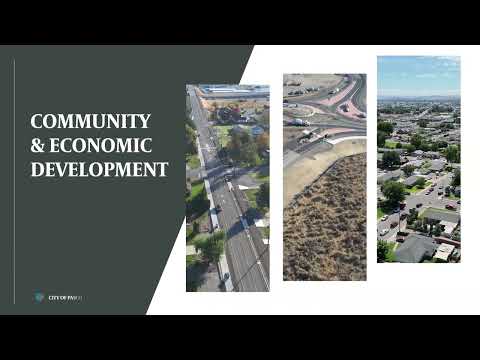
An agency official from Pasco City's Community and Economic Development department outlined the department's core responsibilities and priorities, saying permits are the office's "bread and butter" and that long-range planning must account for projected population growth.
The official said the department manages permits for above- and below-ground work, enforces zoning and follows building codes overseen by "Troy's group," which set safety standards for construction. "Permits, I would say, is our bread and butter for the department," the official said, adding that planners act as a single point of contact through a project's lifecycle.
The presentation flagged a state growth projection the official summarized as "Pasco, you will grow to a 121,000 people in the next 20 years," up from a stated current population of about 85,000. The official said that projection makes it essential to ensure the comprehensive plan and infrastructure ' police, fire, water and sewer ' can keep pace with development. The official referenced the Growth Management Act as a driver of that planning.
On enforcement, the official named two code officers, Javier and Ernesto, and said enforcement is primarily complaint-based: officers address clear life-safety issues and investigate reported illegal activity rather than routinely patrolling every neighborhood.
The official described the Community Development Block Grant (CDBG) program as a federal grant the city uses for low-income housing and home repairs and said it can be used to help small businesses with costly fire-sprinkler engineering studies. The speaker phrased the annual CDBG amount as "around 606 hundred 50000 a year"; the exact annual figure was not specified in the transcript.
The department said it aims to have all permits processed through an online portal by the end of the year so applicants can follow a guided submission flow and receive live updates on permit status. The official also said current permit fees appear to cover "20% or less" of the department's workload and noted the distinction between permit fees and other charges such as traffic impact fees and water/sewer connection fees.
Asked about fire-sprinkler requirements in downtown businesses, the official acknowledged community concerns and said the city is "extremely flexible" while maintaining safety standards; they recommended grant-funded engineering studies rather than waiving safety requirements.
The official closed by pointing to an updated monthly online development projects map that residents can use to check permit numbers and project details and encouraged reporting of unlisted activity for follow-up by code officers. The presentation did not include any formal motions or votes.