Get Full Government Meeting Transcripts, Videos, & Alerts Forever!
Get email alerts on the Annual Action Plan topic
No spam. Unsubscribe anytime.
Santa Clara County advisory committee approves FY 2026–27 annual action plan
Summary
The Housing and Community Development Advisory Committee approved staff recommendations for the county’s fiscal year 2026–27 Annual Action Plan, programming an estimated $7.1 million in CDBG and HOME funds; the draft opens a public comment period through April 28 and will be presented to the Board of Supervisors on April 28.
The Housing and Community Development Advisory Committee on March 25 unanimously approved the county’s fiscal year 2026–27 Annual Action Plan, adopting staff’s funding recommendations for CDBG and HOME programs and opening a public comment period that runs through April 28 ahead of a Board of Supervisors hearing on April 28.
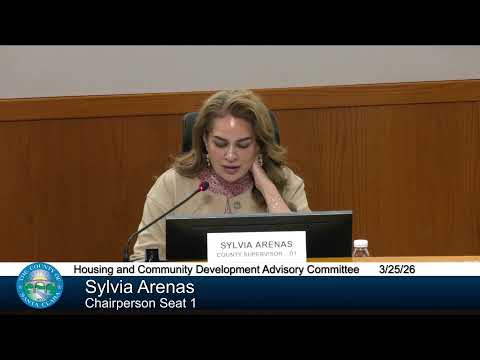
Committee Chair Sylvia Arenas called the special meeting to order and the committee heard a staff presentation from Natalie Monk, HCD manager for the Office of Supportive Housing, and program staff. Katrina Anderson and other staff outlined background on entitlement status, HUD rules and the county’s funding cycle; staff told the committee the county estimates roughly $1.38 million in CDBG entitlement funds and about $800,000 in HOME entitlement funds for fiscal year 2027 and has added contingency language in case HUD’s final allocation differs from those estimates.
Administration described a proposed programming package of approximately $7.1 million in CDBG and HOME funds for FY27 covering public services, fair housing, economic development, housing acquisition/rehabilitation/development, and minor home repairs. Staff said the recommended public service awards include 13 projects estimated to serve about 1,600 people and that the minor home-repair program is projected to fund about 440 repairs for low‑income homeowners. Staff emphasized statutory spending limits for CDBG (no more than 15% of the annual entitlement plus prior-year program income for public services and no more than 20% for program administration) and said program income and prior-year resources are being used to supplement the FY27 portfolio.
Public commenters urged continued support for specific services during the hearing portion. Melanie Ford, community impact manager at Upwards, urged investment in Boost, a program that provides coaching and a childcare-management platform for family child-care providers, saying “fewer than one in three children who need care have access to a licensed slot” and that the average annual cost of infant care in the county exceeds $51,500. Milton Carrera, program director for senior services at Catholic Charities, thanked the committee for recommending $10,093 for the long‑term care ombudsman program and described its role in advocacy and complaint investigation across skilled nursing and assisted‑living facilities. Diane Everton of Rebuilding Together described past funding that supported 477 households and urged continued investment in home repairs, citing studies staff referenced about downstream health‑care savings. Georgia Basile of Senior Adults Legal Assistance and Carol Khan of Project Sentinel similarly thanked staff and urged continued funding for legal and fair‑housing services that serve very low‑income seniors and tenants.
Committee members asked detailed follow‑up questions about which projects are in the HOME pipeline, how program income is defined and used, and how HUD’s exported tables map to county project categories. Staff said some HOME funds are already committed to a Palo Alto project at 3001 El Camino Real and identified a county‑owned site in Gilroy at 8th and Alexander as a possible candidate; staff also said program income (including loan repayments) is often uncertain in amount and timing and is programmed as projects become ready. KJ Kaminski, director for the Office of Supportive Housing, updated the committee on the federal outlook and said the county currently benefits from an injunction that affects HUD enforcement of certain new conditions but that the county can receive and allocate its federal funds while that case proceeds.
Member Yvonne Martinez Beltran moved to approve the action plan and Member Lopez seconded. A roll‑call vote recorded support from all members present and the motion carried unanimously. Staff will present the draft Annual Action Plan to the Board of Supervisors on April 28 and, if approved by the board, staff will submit the plan to HUD and execute agreements with selected service providers for FY27.
Chair Arenas closed by announcing Affordable Housing Month events in May, including a farmworker housing resource fair on May 14 being hosted with SV@Home; staff added notice of a Serna grant award to support agricultural workers and other engagement events related to the regional plan to end homelessness.
What happens next: the public comment period on the draft Annual Action Plan is open through April 28; the committee’s recommendation and the draft plan will be presented to the Board of Supervisors on April 28 for consideration.