Get Full Government Meeting Transcripts, Videos, & Alerts Forever!
Get email alerts on the Ice Response topic
No spam. Unsubscribe anytime.
Parents, educators urge St. Paul Public Schools to expand protections after ICE activity
Summary
Community members and union representatives urged St. Paul Public Schools to formalize supports for immigrant students and staff after reported ICE activity near school sites; the board amended the agenda to add a district ICE-response update, and Superintendent Stacy Stanley described temporary virtual-learning options and community partnerships.
St. Paul — Parents, union members and community advocates pressed the St. Paul Public Schools board on Tuesday to do more to protect immigrant students and staff after reported Immigration and Customs Enforcement activity near school sites.
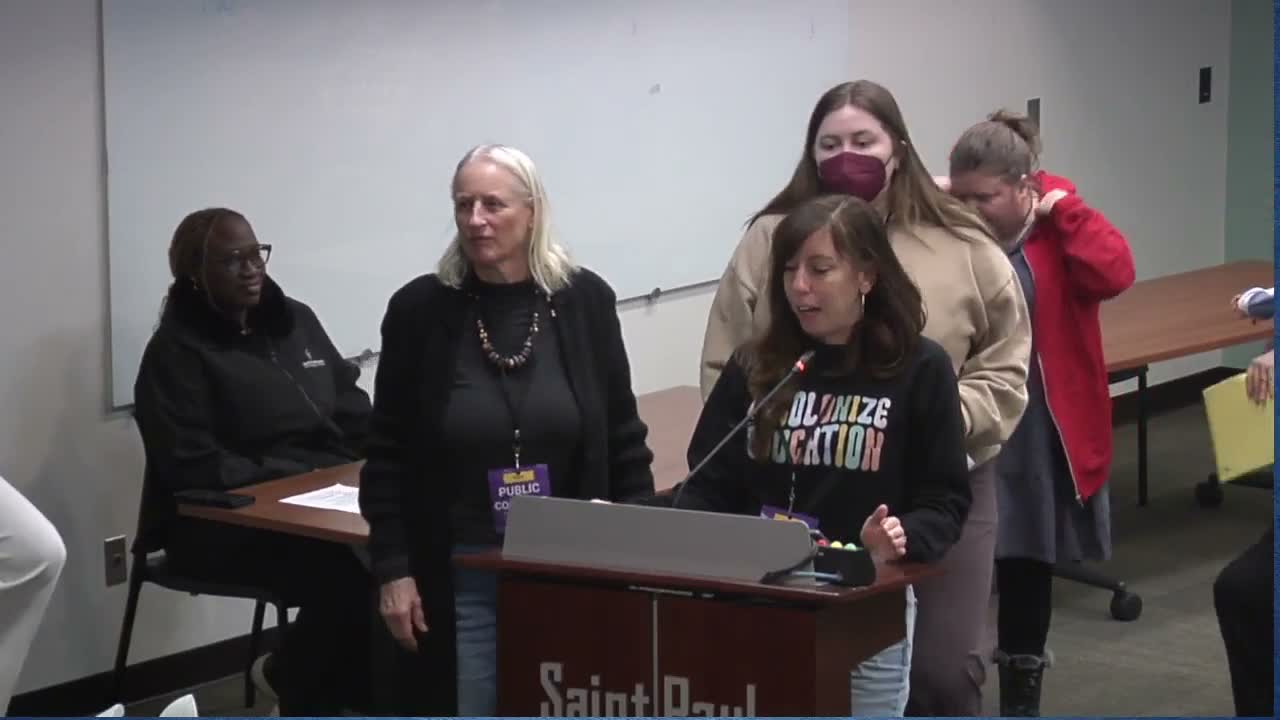
Ally Kildall, a member of the Saint Paul Federation of Educators's Immigration Defense Committee, thanked the district and union for a memorandum of agreement and outlined five explicit requests: establish a standing interdisciplinary committee for immigrant families and staff, create centralized mutual-aid funds and transparent request procedures, suspend attendance robocalls for affected students, require site-level safety plans, and provide staff guidance on secure communication apps. "These are unprecedented and trying times," Kildall said, urging the district to reduce community fear and confusion.
Sandy Velasquez, a parent and member of the Latino consent-decree parent advisory council, told the board that "about 51 percent of Spanish-speaking students" have missed school since the ICE actions began and described families who have temporarily left the city for safety. She asked the board to make flexible home-learning and support accommodations to ensure students do not fall behind.
In response, Superintendent Stacy Stanley said the district began planning in August and expanded efforts in September, invoking the district's emergency operations protocol and interagency coordination. Stanley said the district launched an "optional temporary virtual-learning" program for families who choose to learn from home for safety reasons and that "thousands of students" had registered by the enrollment deadline. She said the plan provides synchronous instruction where possible and that the district is working with community partners to provide hotspots, devices and temporary food assistance.
Stanley described operational steps the district is taking without giving operational specifics that could compromise safety: updated translation and robocall practices, video outreach in families' preferred languages, safety-and-security teams visible in neighborhoods, coordination with the Saint Paul Police Department, and outreach to former local leaders and legislators to prepare for multiple contingencies. "We are not going to be able to eliminate trauma," she said, "but our goal is to take care of our kids and minimize it as much as we possibly can."
The board voted unanimously earlier in the meeting to amend the agenda to add a formal informational report on the district's ICE response under informational items; Superintendent Stanley said she would provide a fuller update in that section of the meeting and that the temporary virtual option will be reviewed weekly.
The public speakers and the superintendent agreed on the need for culturally responsive communications and clearer, centralized supports. Vice Chair Valiant and multiple directors also urged coordination with city and state officials on enrollment and attendance policies to avoid automatic unenrollment for students who miss extended periods amid safety concerns.
Next steps: the board added the ICE-response item to the meeting agenda and heard the superintendent's more detailed informational report later in the meeting; board members raised follow-up items, including publishing centralized resources on the district website and continuing regular updates as circumstances evolve.