Get Full Government Meeting Transcripts, Videos, & Alerts Forever!
Get email alerts on the SB 289 University Records topic
No spam. Unsubscribe anytime.
Committee holds university‑records bill after debate over donor confidentiality and finalist disclosure
Summary
Senate Bill 289, which would narrow public‑records disclosure for university searches, research and foundation donors, prompted sustained questioning from committee members and criticism from the press association; the sponsor agreed to work with stakeholders and the committee held the bill for revision.
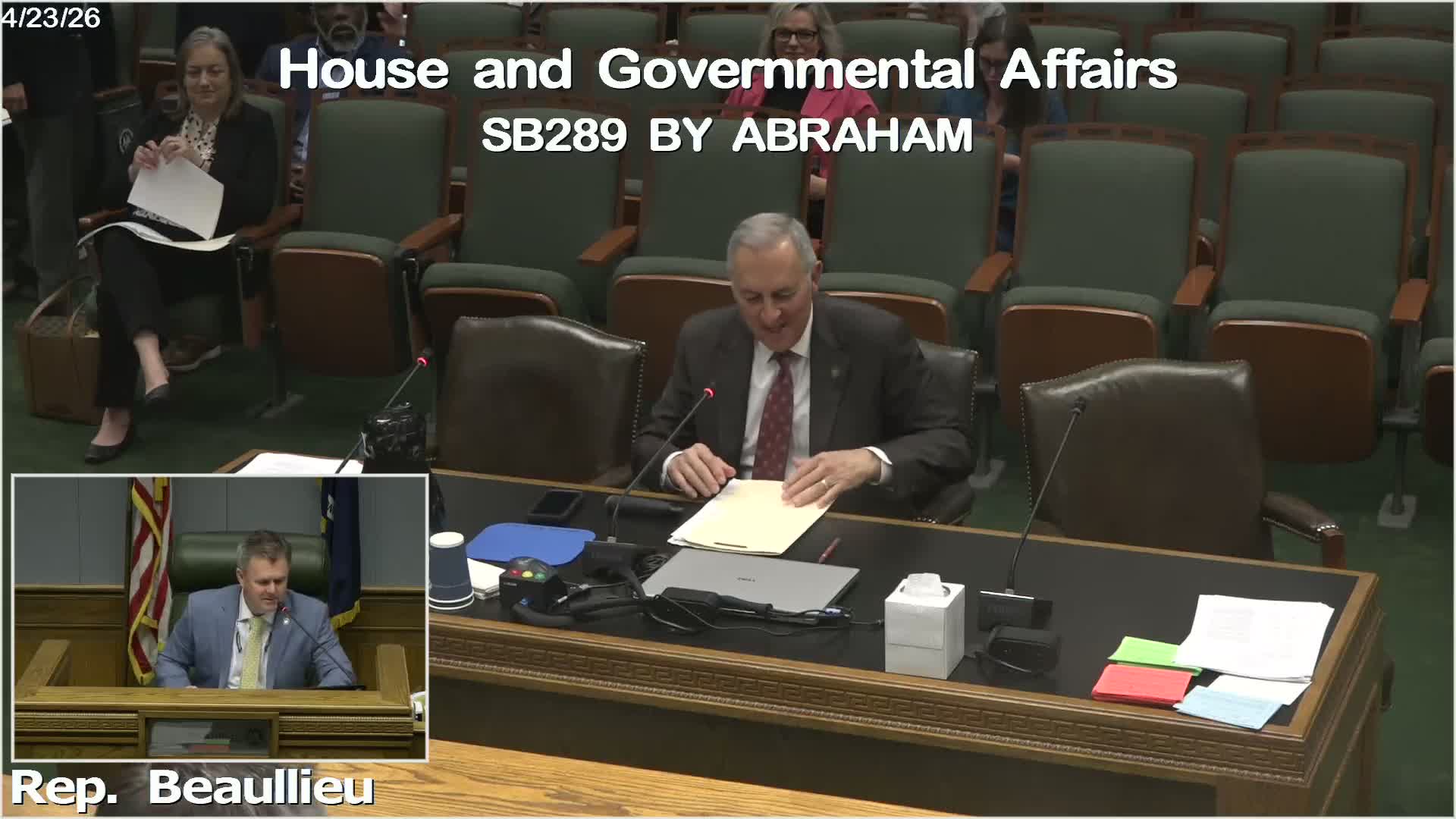
Senate Bill 289 drew sustained scrutiny in the House Governmental Affairs committee on April 23 as lawmakers, agency officials and media representatives questioned whether the measure would unduly restrict public accountability.
Senator Abraham, the bill’s sponsor, said the bill addresses four discrete concerns: limiting disclosure of non‑finalist applicants in executive searches so that only finalists are revealed; permitting universities to withhold certain research records until projects are complete; allowing donor information that began as private to remain confidential if transferred from a private foundation to a public university; and permitting donors who give directly to a university to request confidentiality. Abraham said the proposal balances donors’ privacy with appropriate transparency for finalists.
"This bill says that only the finalists will be revealed, not all the other applicants," Abraham told the committee, and he described amendments to ensure at least three finalists are disclosed in the search context when fewer candidates would otherwise be labeled "finalist." He said the change responds to experiences where a single publicized finalist drew criticism and raised concerns among prospective applicants.
The Louisiana Press Association, represented by Scott Sternberg, pressed the sponsor on the donor‑confidentiality provisions. Sternberg said foundations such as the LSU Foundation file federal Form 990 information and that the public currently can learn who gave money; he warned that broad exemptions could create a transparency gap.
"I think that determining how that person was selected is getting harder and harder for the public," Sternberg said, urging caution about creating exceptions that could be expanded beyond their stated purpose. He told the committee Abraham’s amendments alleviated some concerns, particularly the finalist‑disclosure language, but said the donor provisions still raised questions about public accountability.
Committee members probed the practical effects. Representative Newell and others asked whether universities routinely need donor lists to identify potential funders; Senator Abraham said the change would let private donors who gave anonymously to a foundation remain private if the donor wanted that confidentiality to persist when funds moved to a university. Representative Larvain raised concerns about a "dark money" possibility if transfers were broadly exempted from disclosure.
After extensive questioning and input from the Press Association and other members, the committee did not vote the bill forward. The chair said the sponsor and committee staff should work with the Louisiana Press Association and other stakeholders to tighten the language and resolve concerns before returning SB 289 to the committee.
Next steps
Senator Abraham agreed to meet with the Press Association and committee staff to revise the bill. The committee held SB 289 for further work rather than reporting it out.