Get Full Government Meeting Transcripts, Videos, & Alerts Forever!
Get email alerts on the Suki Facilities topic
No spam. Unsubscribe anytime.
Board rejects work-group interim plan for Hmong programs, directs unified preK–8 timeline and near-term fixes
Summary
After hours of public testimony from Hmong students, parents and community leaders, the Saint Paul Public Schools board voted down the work-group’s interim plan to move Hmong studies to Prosperity Heights (Option A) and instead directed the superintendent to accelerate the district’s unified preK–8 plan and take near-term steps to ease overcrowding.
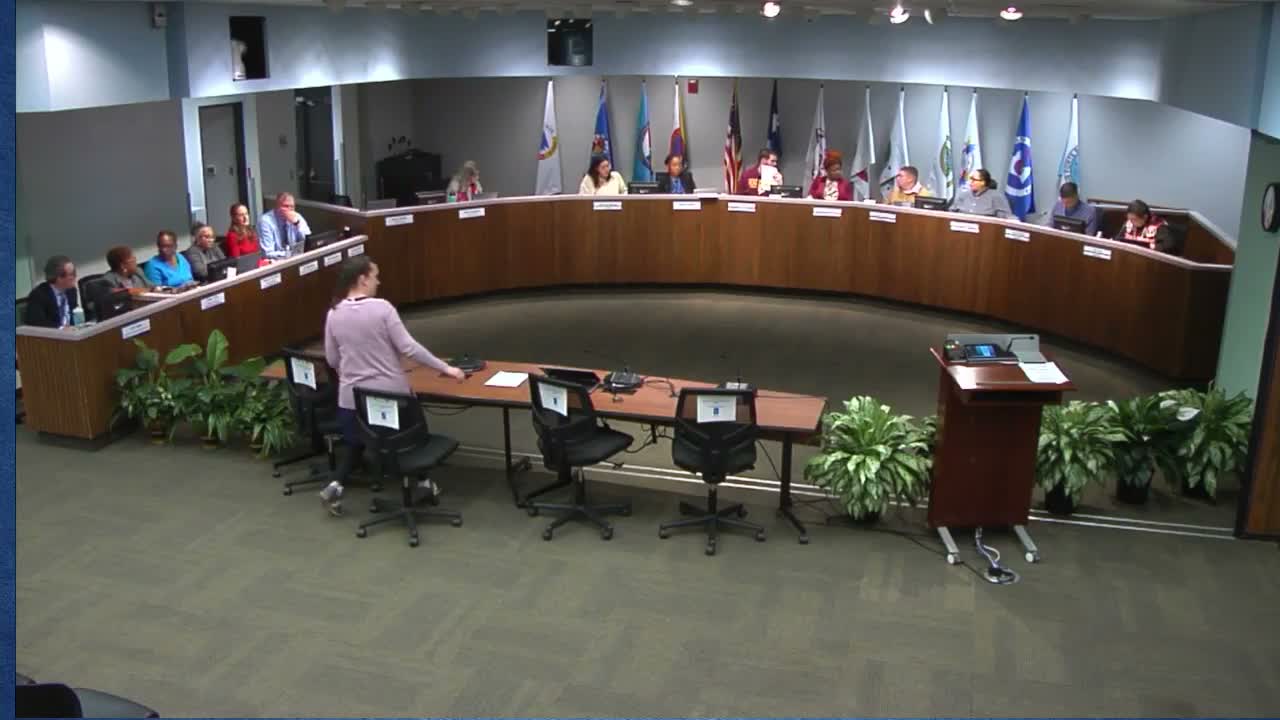
After nearly three hours of public comment and a lengthy board discussion on Dec. 18, the Saint Paul Public Schools Board of Education rejected the facilities work-group’s interim recommendation to move the Hmong-studies program to Prosperity Heights and instead approved a directive asking the superintendent to accelerate the district’s long-term unified preK–8 plan and take immediate steps to reduce crowding at Tzu Chi (TSUKI) campuses.
The board’s vote on the work-group recommendation — known as Option A, which would have moved Hmong studies K–4 to Prosperity Heights and returned fifth grade to the lower campus — failed on a 1–6 tally. Director Pat Vu, who presented the work-group recommendation and urged the board to accept it, was the lone affirmative vote. After the failed motion, Director Victor Franco offered a substitute directive that passed 6–1.
The adopted directive instructs the superintendent and administration to move forward with the existing plan for a unified preK–8 facility for the Hmong programs and to take three near-term actions: ensure the new preK–8 building is operational no later than the 2032–33 school year, increase specialist allocation to the fifth-grade program by at least 1 full-time equivalent for the 2026–27 school year, and work with building leaders to identify ways to maximize current space at Tzu Chi upper and lower — including cafeteria capacity, busing and assembly/community space.
The vote followed a packed public-comment period in which students and parents described concrete problems at Tzu Chi: overcrowded lunchrooms with late service times, limited access to specialists for fifth graders who attend a middle-school campus, and stretched classroom and restroom facilities. "Doing nothing means I stay hungry and my language disappears," said a fourth-grade student who identified herself as a Tzu Chi pupil and urged the board to support Option A and long-term investment in Hmong-language programming.
Proponents of Option A argued it would preserve and grow both Hmong studies and the Hmong dual-language program while avoiding co‑location with another school. Director Vu, summarizing the work-group’s recommendation, said: "All we do is we ask you to vote in favor of the recommendation. That's Option A." Opponents — including several board members who conducted site visits — said the Option A plan had been introduced abruptly for some school communities, raised safety and capacity concerns at the proposed sites, and risked fracturing program integrity over a long interim period.
Superintendent Stanley acknowledged harm caused by how the options surfaced in district communications and offered a public apology during her remarks: "The impact was culpable, and I offer my heartfelt apology for this." Board members repeatedly returned to trust and process: several said they supported the work-group’s effort but rejected the specific options as insufficient to meet the communities’ needs.
The board’s adopted directive emphasizes both an accelerated commitment to the unified preK–8 facility and immediate operational improvements while the larger capital project moves through phase gates. Board materials presented alongside the motion show the preK–8 project remains in the district facilities plan and the board asked administration to maintain momentum toward phase-gate milestones.
What’s next: the work-group has said it will bring a draft resolution with mission, vision and goals in February (phase-gate and resolution dates were discussed during the Hmong Project presentation). The board’s directive includes an explicit near-term staffing and space mandate for 2026–27; administration must now return with implementation steps and timelines.