Get Full Government Meeting Transcripts, Videos, & Alerts Forever!
Get email alerts on the Committee Roundup topic
No spam. Unsubscribe anytime.
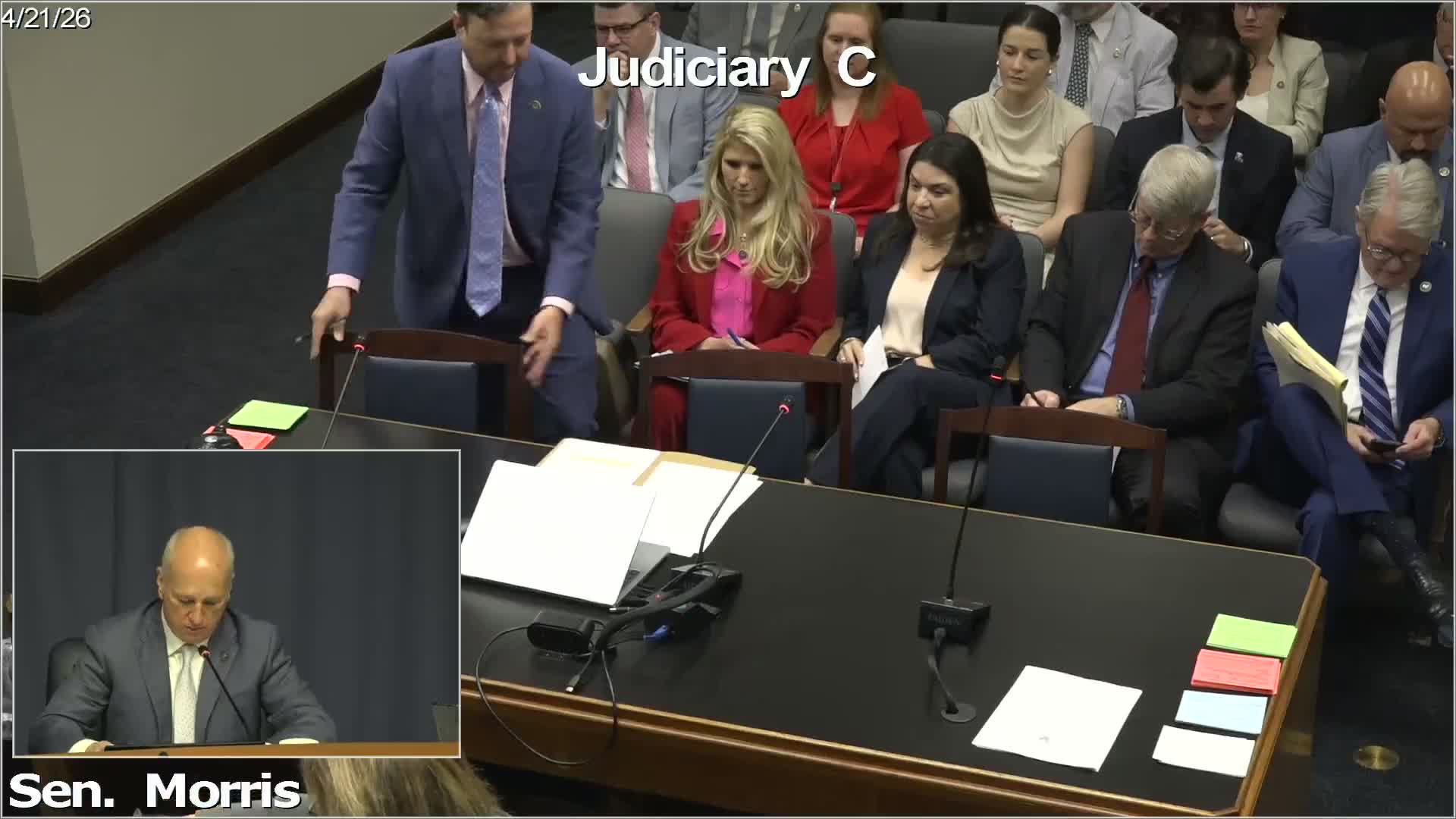
Judiciary C committee reports a package of criminal‑justice bills, including tougher elder‑abuse penalties and evidence reforms
Summary
The Judiciary C committee reported a slate of criminal‑justice and public‑safety bills favorably, including measures to allow electronic access to child‑victim video statements, increase penalties for cruelty to elderly or disabled residents, clarify post‑conviction relief procedure, and permit seizure/forfeiture for reckless off‑road vehicle use. One retroactivity amendment on a jury‑trial threshold bill failed on a roll call.
The Judiciary C committee met and reported a series of criminal‑justice and public‑safety bills, advancing measures that the attorney general and local prosecutors brought to the panel.
House Bill 995, presented early by Representative Lacombe and supported by Darren Aleman of the Jefferson Parish District Attorney’s office, would permit district attorneys to provide copies of videotaped statements of protected persons via electronic access while preserving constitutional rights of defendants. The committee voted to report HB 995 favorably by unanimous consent.
The committee adopted an amendment and reported House Bill 98 favorably with the amendment; sponsors said the bill strengthens confidentiality protections for victims of domestic violence, sexual assault, trafficking and minor victims and adds penalties for intentional disclosure. Larry Freeman of the attorney general’s office and other AG staff were repeatedly present in support across bills.
Law‑enforcement and prosecutors generally supported several other bills reported favorably by the committee, including HB 336 (statutory deadlines and procedures for post‑conviction Rhine stays), HB 171 (technical citation fixes in bail/surety provisions), HB 245 (parole‑board notice timing for medical parole), HB 280 (juvenile statute clean‑up), and HB 305 (streamlining how arresting agencies submit child sexual‑abuse material to NCMEC).
Two bills drew more extended debate. HB 102, carried by Representative Wiley for the attorney general, would increase penalties for egregious cruelty against elderly and infirm residents. Matthew Stafford of the AG’s Medicaid Fraud Control Unit described ongoing prosecutions and said the bill targets instances that cause serious bodily injury or death. A parent and advocate, Koranda Corley, urged the committee to expand the caregiver definition to encompass local education agency employees and contracted school staff; sponsors signaled willingness to explore amendments between committee and floor consideration.
House Bill 52, which raises the fine threshold that triggers a defendant’s right to a jury trial from $1,000 to $2,500 and included a retroactive correction tied to a prior DWI fee change, produced one contested procedural fight. Senator Barrow offered an amendment to remove the retroactivity; the amendment failed on a roll call (4‑nay, 1‑yea recorded in committee). The committee then reported the bill favorably (roll call recorded in the transcript).
HB 789 (allowing seizure and sale of off‑road vehicles used in reckless operation) and HB 294 (a narrowly defined statute allowing churches to remove disruptive individuals and providing limited civil‑liability protections) were both reported favorably after proponents and opponents discussed drafting and safeguards; advocates, law‑enforcement groups and the ACLU offered competing views on scope and immunity.
What’s next: Most of the bills the committee reported will move to the floor for additional consideration; sponsors said some drafting adjustments and targeted amendments may be worked out between committee action and floor debate, particularly for HB 102 and HB 294.
Votes at a glance (as recorded in committee transcript): - HB 995: reported favorably (unanimous consent). - HB 98: amendment adopted; reported with amendments (unanimous consent). - HB 336: reported favorably (unanimous consent). - HB 171: reported favorably (unanimous consent). - HB 102: reported favorably (unanimous consent after testimony). - HB 54: deferred by unanimous consent. - HB 245: reported favorably (unanimous consent). - HB 280: reported favorably (unanimous consent). - HB 52: amendment to remove retroactivity failed on roll call (recorded 4‑nay, 1‑yea); bill reported favorably (roll call recorded in transcript). - HB 789: reported favorably (unanimous consent). - HB 305: reported favorably (unanimous consent). - HB 131: reported favorably (roll call recorded). - HB 294: reported favorably (unanimous consent after amendments/discussion). - HB 231 (transcript lists 231/331): reported favorably; committee adjourned.
Key voices quoted in the hearing included Matthew Stafford, principal investigator with the Medicaid Fraud Control Unit, who said prosecutors are seeing "beaten, bruised, broken, tortured" victims and argued for tougher penalties for the most egregious cases; and Koranda Corley, a parent and advocate, who said, "I am the proud parent of a child with a disability... I am begging and imploring y'all to please add an amend caregiver to include local education agency employees and their third party contracted individuals."