Get Full Government Meeting Transcripts, Videos, & Alerts Forever!
Get email alerts on the Development Review topic
No spam. Unsubscribe anytime.
Alachua County commissioners back staff effort to streamline small-scale development reviews
Summary
County commissioners instructed staff to draft code revisions to limit when small projects must go to the Development Review Committee, expand prescreening and create a Minor Development Plan category to reduce costs and delay for small accessory projects.
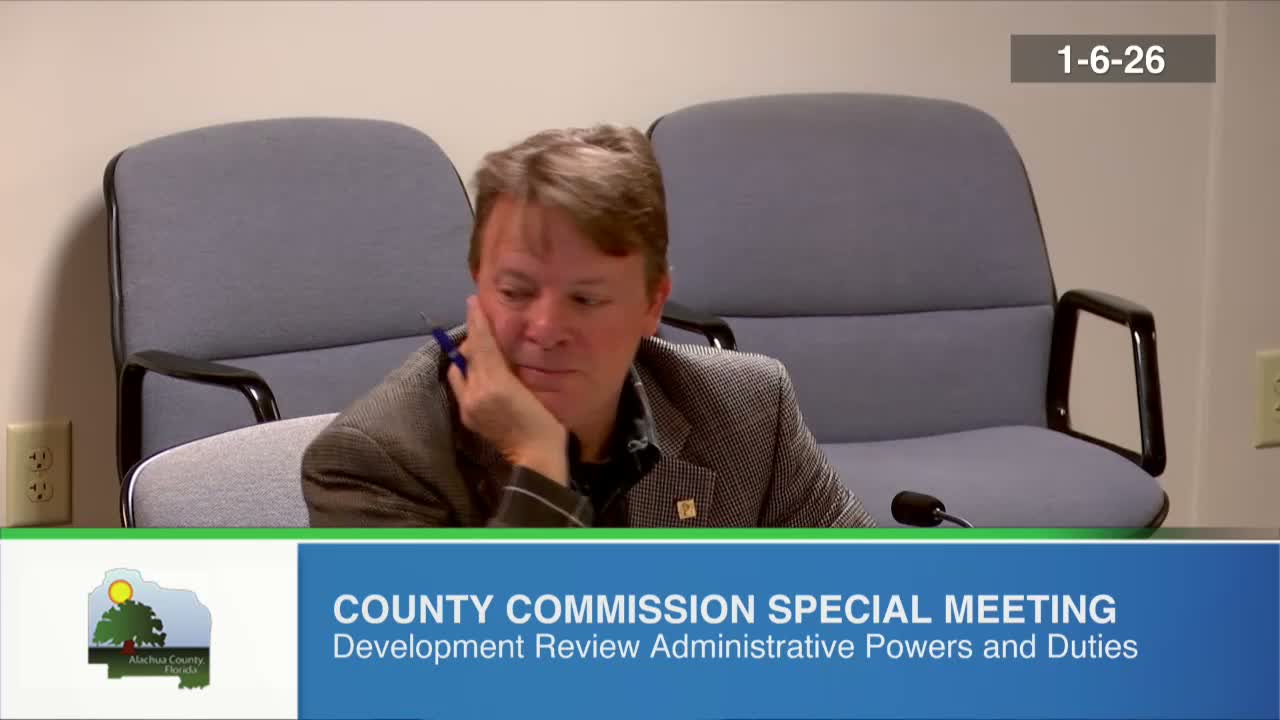
At a board workshop, Alachua County staff outlined proposed changes to development-review thresholds and administrative review processes intended to keep small projects from triggering full public hearings.
Christine, the planning presenter introduced by staff, told commissioners that current rules send projects with more than 1,500 square feet of additional impervious surface to the Development Review Committee (DRC). "The thresholds tend to be based on an impervious area amount, 1,500 square feet," she said, and noted that the rule has forced relatively modest improvements — a covered patio at a fitness campus and an amenity-center pickleball court — into the public-hearing process.
Staff argued that many of those smaller projects could be handled through the county's free prescreening process in CitizenServe, which routes applications to environmental protection, public works and growth-management reviewers for quick checks without the fee and delay of a formal administrative development plan. "We have a free prescreening process that goes into CitizenServe… It happens pretty quickly," a staff member said, describing the steps that flag tree, stormwater or utility issues.
Commissioners focused on two questions: which rules intended for greenfield development must continue to apply to small changes (for example tree‑canopy and landscaping requirements) and how to prevent a series of incremental additions from evading review. One commissioner urged maintaining stormwater protections, saying staff should avoid creating a process that permits "taking bites at the apple" so that a property owner could sidestep full review by adding improvements piecemeal.
Staff proposed creating or clarifying a "Minor Development Plan" category and adding size, use-change or cumulative thresholds that would distinguish small accessory or accessibility improvements from larger redevelopment. "We'd like to rework these, consolidate them, and clarify what's applicable to greenfield development versus maybe a small addition," Christine said.
Public commenters and several commissioners urged streamlining while preserving environmental protections; one member recommended a simple chart or table showing where different project types fall in the review process.
After discussion, the board unanimously moved and seconded a five-part direction asking staff to draft proposed code changes and return with a formal request to advertise the revisions. The board did not adopt specific code language at the meeting; staff said it would take the proposed thresholds and definitions to stakeholders, including the builders association, before returning with a request to advertise a draft ordinance.
Next steps: staff will prepare draft code language, seek stakeholder feedback and return to the board with a request to advertise the amendments for public hearing.