Get Full Government Meeting Transcripts, Videos, & Alerts Forever!
Get email alerts on the County Budget topic
No spam. Unsubscribe anytime.
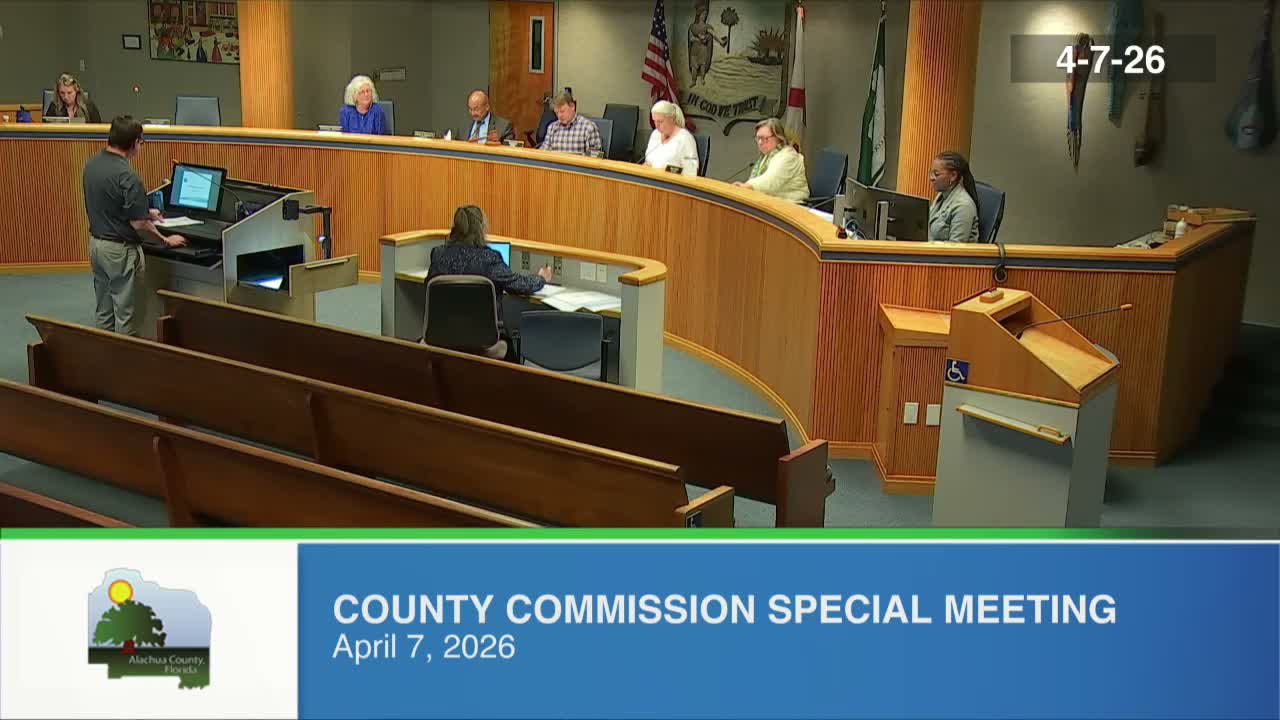
Alachua County adopts budget calendar, staff outlines revenue risks and reserve plan
Summary
The Alachua County Commission unanimously adopted a budget calendar April 7 as staff presented multi-year financial trends, reserve targets and contingency plans for possible state property-tax changes that could cut county revenues.
The Alachua County Board of County Commissioners on April 7 voted unanimously to adopt a budget calendar and heard a comprehensive presentation on financial trends, reserve targets and planning for potential state property-tax changes.
Presenter (staff finance lead) laid out the proposed schedule — including estimated values from the property appraiser by June 1, county-manager presentations in early July and tentative millage-setting in mid-July to meet TRIM notice deadlines — and described department-level deep dives in June and August to finalize priorities.
The presenter told the board the county is consolidating several subfunds into the general-fund presentation to make trends clearer and flagged major revenue drivers: property taxes, fire assessments, stormwater and gas tax receipts. He said property-tax revenues have grown roughly in line with inflation and market trends, while fees for ambulance and charges for services have risen substantially in recent years.
Context: staff said the county’s unassigned general-fund balance rose from $24.5 million in 2019 to about $57.9 million in the most recent preliminary numbers (over 23% of expenditures). They recommended approaching fiscal 2026 with a plan to modestly draw down the balance toward a target zone (around 20–21%), while preserving a minimum working reserve (best practices cited at roughly 17%).
On risks, staff warned commissioners about pending state proposals to expand homestead-exemption rules. Presenter said the rollback-rate math can produce counterintuitive results — including the possibility of a slight millage increase to offset lost taxable value — and estimated a large hypothetical loss in taxable value if broad homestead exemptions pass. To protect core services, staff recommended budgeting a conservative $4 million of recurring revenue increases for the FY26 baseline and setting roughly $10–11 million of one-time new revenue into nonrecurring projects or debt reduction in case state action reduces future revenue streams.
Commissioners asked about hiring and FTEs. Manager Lieberman and staff clarified the guideline of “no new FTEs” means departments may fill vacancies and reassign positions as needed but should not add recurring positions without board approval. The board discussed potential impacts of inflation, pay increases and one-time costs such as initial body-worn-camera purchases and an ongoing jail study.
The chair then asked for a motion to adopt the budget calendar; Commissioner Christopher Alford moved, Commissioner Christopher Wheeler seconded, the board took public comment and then voted to approve the calendar unanimously.
What’s next: staff will return with the fee study and departmental deep dives in June and an August schedule that will allow the board to consider adjustments and one-time allocations ahead of tentative millage-setting in July and final adoption later in the year.