Get AI Briefings, Transcripts & Alerts on Local & National Government Meetings — Forever.
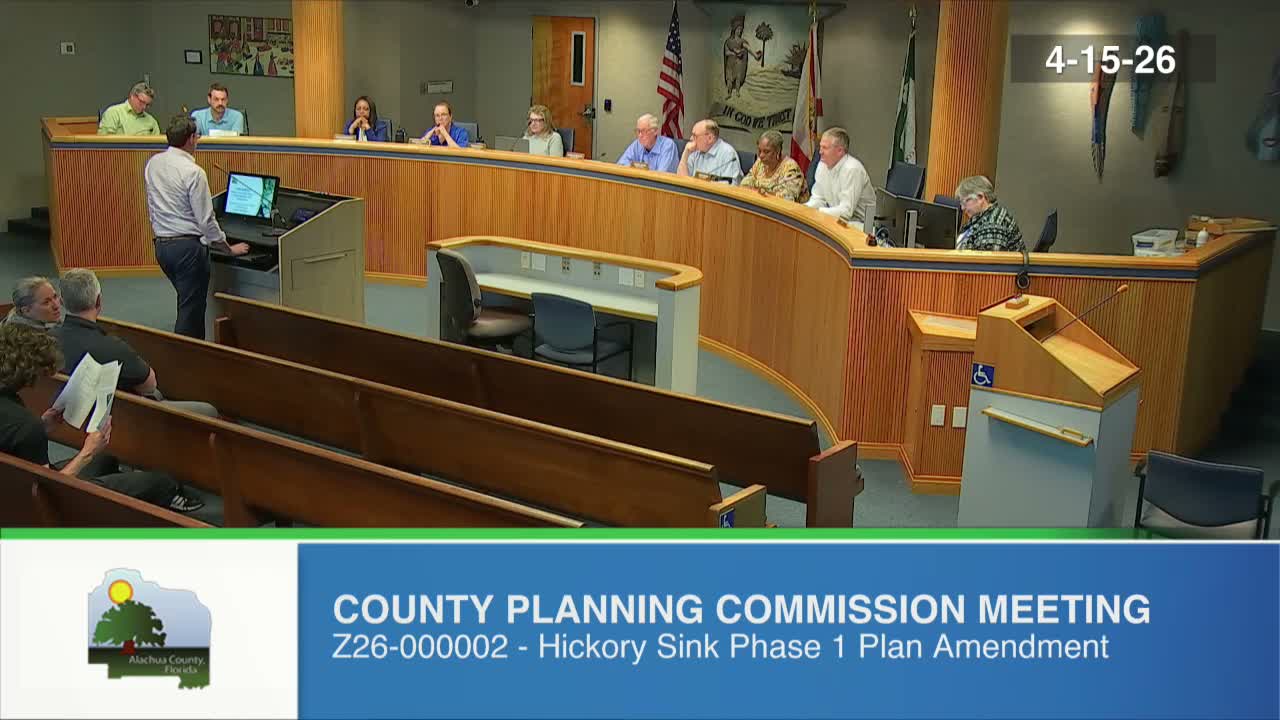
Planning commission recommends transmission of Hickory Sink large‑scale plan and approves PD rezoning for UF Foundation golf project
Loading...
Summary
After hours of technical briefing and public comment, the Alachua County Planning Commission voted to transmit a large‑scale comprehensive plan amendment for a 580‑acre UF Foundation golf‑course project in the Hickory Sink strategic ecosystem to Florida Commerce and recommended approval of the companion Planned Development rezoning with conditions and BMPs; one commissioner opposed the land‑use change citing incompatibility with the strategic ecosystem.
The Alachua County Planning Commission voted to transmit a large‑scale comprehensive plan amendment for about 580 acres owned by the University of Florida Foundation and recommended approval of a planned‑development (PD) rezoning that would implement a championship golf‑course project, while adopting a set of site‑specific policies and best‑management practices intended to protect sensitive natural resources.
Chris Dawson, principal planner for development services, told the commission this application implements Phase 1 of the Hickory Sink special area study (SAS) and would create a new "UF Golf Institutional" future land use for the UF Foundation property. Staff presented policy language (objective 8.6 and policies 8.65 series) describing conservation management areas (CMAs), limits on irrigation and nutrient application, a required nutrient‑management and water‑quality monitoring program, and a requirement that potable water and sanitary sewer be extended to serve the development to avoid unsustainable well use.
"The special area study included data analysis, stakeholder workshops and a resolution accepting the study in November 2023," Dawson said, adding that the plan identifies conservation areas and site‑specific policies that the PD will implement.
Environmental protection staff described monitoring and adaptive management commitments. Stacy Greco, Water Resources Program Manager, said the nutrient‑management plan is included among BMPs and requires groundwater and surface‑water monitoring before and after construction; monitoring frequency is quarterly for the first three years and may drop to twice a year if targets are met, with adaptive management if standards are not achieved. "There is a nutrient management plan. It is one of the BMPs. . . . So there will be groundwater and surface water monitoring before construction and after construction," Greco said.
University representatives and the project team outlined project goals and technical expertise. Chuck Clemens, vice president for government affairs and community relations, said the University and the foundation view the proposal as an opportunity for research, education and community programming in addition to athletics. "We have gone above and beyond," Clemens told the commission, describing extensive consultant support.
Applicant witnesses emphasized stormwater capture, reclaimed water and BMPs as primary tools to reduce potable groundwater demand and nutrient loading; UF turf and BMP experts said the project proposes monitoring and reporting to Florida DEP and the county and that nutrient accounting will include reclaimed water constituents.
Several commissioners expressed concern about siting a large golf course within a strategic ecosystem. Commissioner (S11) told colleagues he would oppose the transmission of a 500‑plus acre golf course in a strategic ecosystem regardless of BMPs. "Because of this and other reasons, I cannot support 500 acres of golf courses in a strategic ecosystem," S11 said. Despite that objection, the commission voted to transmit the large‑scale comprehensive plan amendment; the transcript records the result as 5 to 1 in favor with one abstention noted by staff.
The commission then considered the companion Planned Development rezoning (Z26000004) that would implement the comp‑plan designation. Staff explained five BMPs (stormwater, nutrient management and water‑quality monitoring, landscape restrictions and irrigation limits, natural resources/karst management and permanent protection of CMAs) and several conditions addressing karst feature identification, access management, buffer planting, visitor cottages (up to 30 short‑term guest cottages) and pedestrian/bicycle connections. The PD hearing included technical briefings by the applicant's golf‑course architect and UF IFAS turf and BMP specialists.
A motion to recommend approval of the PD zoning with the agreed conditions carried on a commission vote; the transcript records the motion as passing (record does not show a detailed roll call for that vote in the provided excerpt).
Next steps: staff will transmit the large‑scale comprehensive plan amendment to Florida Commerce for state review; following state comments the Board of County Commissioners will consider adoption and the PD rezoning will return for county action and later site‑plan review and permitting.
Speakers quoted in this article include county staff, Environmental Protection staff, applicant representatives and commissioners; direct quotes are attributed to speakers who appear in the meeting record.