Get Full Government Meeting Transcripts, Videos, & Alerts Forever!
Get email alerts on the Animal Shelter topic
No spam. Unsubscribe anytime.
Residents press Alachua County commissioners to act after whistleblower letter; board orders review and temporary supports
Summary
Dozens of public commenters detailed alleged neglect and retaliation at Alachua County Animal Resources and asked for immediate action. The county retained an independent investigator under its whistleblower ordinance, and the commission unanimously approved a multi-part motion to convene its Animal Welfare Advisory Committee, consider volunteer protections and interim management alternatives, and fund temporary assistance.
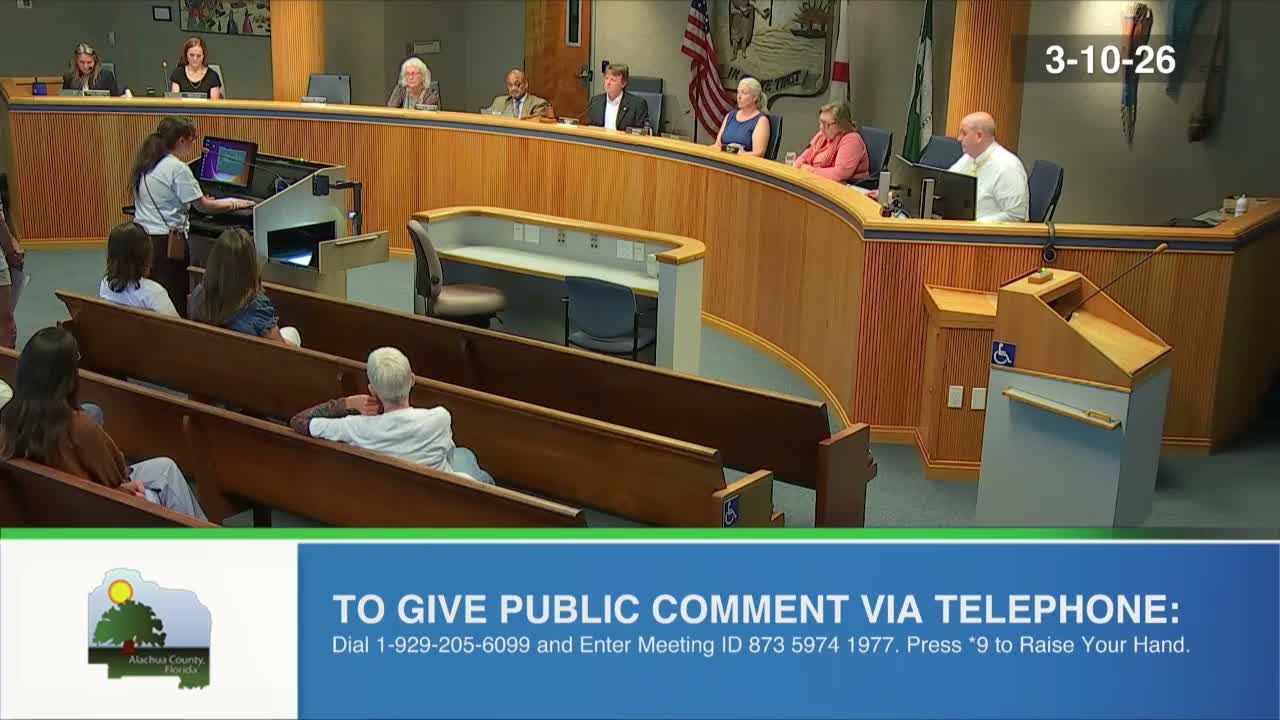
Dozens of residents told the Alachua County Board of County Commissioners on March 10 that the county's animal shelter is failing animals and volunteers, pressing the board to step into an unfolding investigation and to provide immediate operational help.
The meeting, which drew multiple callers and crowded public comment, focused on a whistleblower letter received March 2 that alleges poor sanitation, unnecessary euthanasia and retaliation against staff and volunteers at Alachua County Animal Resources (ACAR). ‘‘If this board waits to act until the investigation concludes, we fear that conditions for the animals will continue to plummet,’’ said Patricia Antonucci, a longtime volunteer, during public comment.
Why it matters: Commenters and volunteers said the allegations, if sustained, would undermine the shelter's mission and public trust at a time when the county is planning a new shelter building and recruiting a director. Multiple speakers asked the board to suspend implicated managers from hiring consideration and to increase transparency about where animals transferred to outside rescues were placed.
What county staff said: Manager Michelle Lieberman told the board that the county has retained an independent third party to conduct an external investigation and that the county attorney's office is managing the scope. County Attorney Torres said the whistleblower disclosure triggered the county's whistleblower ordinance (Chapter 3, Article 2) and that the external investigation must be completed within 90 days unless extenuating circumstances exist (the statutory 90-day window points to an initial deadline of May 31, 2026, which the county noted may translate to June 1 if the 31st falls on a Sunday).
Lieberman also outlined personnel steps already under way: the county has completed a national recruitment and reported that a veterinarian candidate has accepted an offer and is scheduled to start on May 4. She said three finalists for the shelter director were interviewed by the manager's panel and that final interviews were imminent.
Board action: Responding to public testimony, Commissioner (speaker 14) moved a five-part directive that the board approved unanimously. The motion instructed staff to: (1) convene the Animal Welfare Advisory Committee (AWAC) as soon as possible to review operating procedures and provide recommendations; (2) allow AWAC to weigh in on shelter design when architecture/engineering is available; (3) explore a whistleblower or complaint policy that explicitly protects volunteers and clarifies how volunteers may raise concerns; (4) ask the manager to examine alternatives for interim management of the shelter during the investigation; and (5) provide temporary resources (staffing or other assistance) to support animal services while leadership is stabilized. The board's action included referral to the county attorney's office and manager for implementation.
Reaction from volunteers and advocates: Public commenters urged that any candidate who is the subject of the investigation be removed from consideration for the director post; several asked that volunteers be shielded from retaliation and that the board be part of the director selection process. Volunteer leaders described kennel conditions, alleged unusual euthanasia patterns, and said the shelter had locked volunteers out in ways that reduced oversight. ‘‘We will not let this go and we are counting on the BOCC to help oversee the rebirth of our shelter,’’ one volunteer said.
Next steps and timeline: The independent investigation is under way and will be managed through the county attorney's office. Staff told the board the investigative scope is not limited and may encompass all allegations raised in the whistleblower disclosure. Commissioners asked staff to bring AWAC together promptly and to report back on short-term staffing and operational changes; the board also asked that volunteers be made aware of complaint procedures and that staff provide periodic status updates.
Authorities and constraints: County leaders stressed that personnel hiring is the manager's prerogative; the board can set policy and oversight but generally does not direct individual hiring decisions. County staff said public records requests related to transfers of animals may require limited redactions for personal information under a recent records exemption, and the county attorney's office will review which records can be released.
What remains unresolved: Volunteers and advocates are seeking the identity and status of more than 10 animals transferred on a specific February date; staff said public records are under review and may be released with limited redactions. The external investigation's findings, any recommended personnel actions and whether specific staff will be suspended or removed will depend on that outside review and follow-up steps.
The commission agreed the AWAC should meet immediately and that temporary on-site resources should be made available while the investigation proceeds. The board voted unanimously in favor of the motion at the meeting and instructed staff to report back with implementation actions and timelines.