Get Full Government Meeting Transcripts, Videos, & Alerts Forever!
Get email alerts on the Code Enforcement topic
No spam. Unsubscribe anytime.
Alachua County magistrate hears dozens of code-enforcement cases; rescinds fines for tax-deed buyer who cleared property
Summary
The Alachua County special magistrate heard more than two dozen enforcement matters, ordering compliance deadlines and daily fines in multiple cases, finding several properties back in compliance, and reducing to zero accumulated fines for a buyer who cleared and began renovating a tax-foreclosed property.
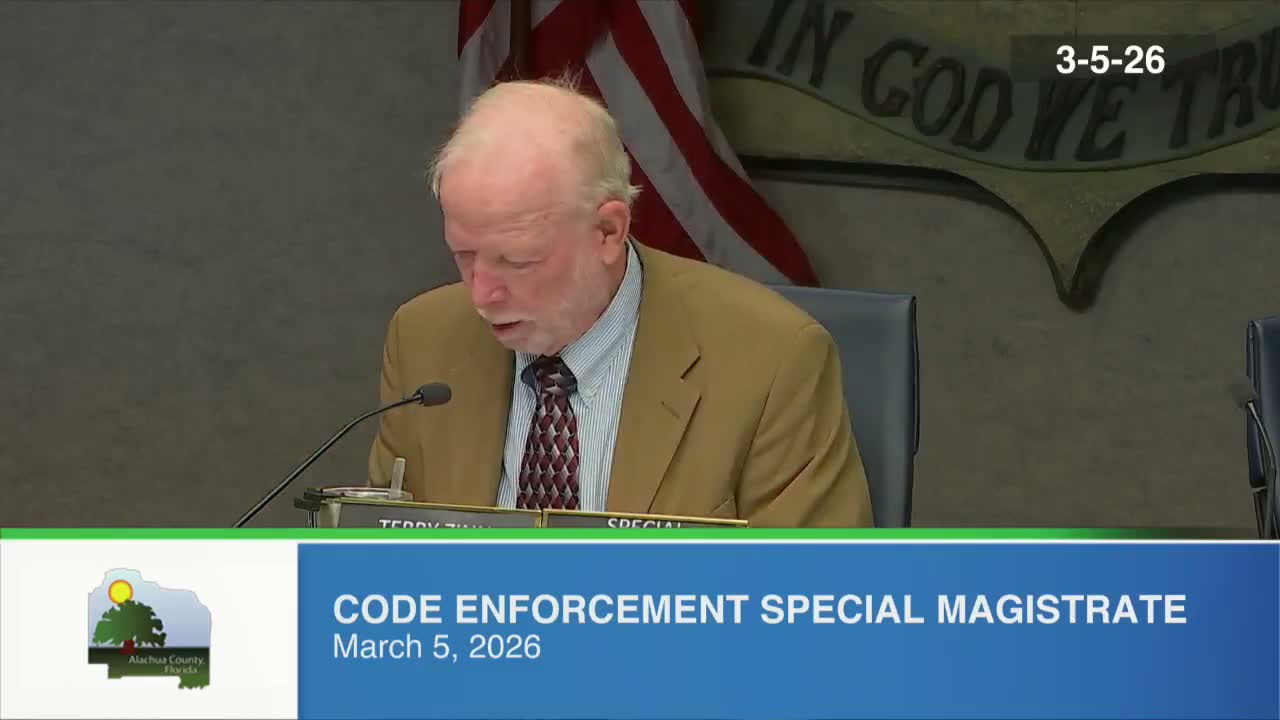
The Alachua County Code Enforcement Special Magistrate convened a morning hearing to consider more than two dozen alleged ordinance violations, from tree removals along a designated scenic corridor to sewage discharge, junk and debris, unpermitted building work and nuisance overgrowth. The magistrate administered the oath to all testifying witnesses and proceeded through a reordered docket that included both initial-violation hearings and a penalty phase for previously adjudicated cases.
The county presented evidence in a tree-removal case on Millhopper Road, where Andrew Caniglio, a senior forester and code officer for Alachua County, said the county received a complaint on Jan. 7 and photographed ten removed trees. Caniglio told the magistrate the county recommends a 90-day deadline to come into compliance and, if the property owner does not comply, a $50 daily fine and a $5,000 request for irreparable-damage penalty in addition to $140 in prosecution costs. "The county recommends the respondent be found in violation… and if not in compliance, then pay a fine in the amount of $50 for each day," Caniglio said. Neil Gresha of Alachua County Public Works, who took the photographs, corroborated the count: "I counted the 10 trees," Gresha said. A contractor who identified himself as the manager for Gadsden's Tree Service said five trees were dead, that remaining trees were storm-damaged and that he had applied for permits for the work still needed.
In a separate matter, Gregory Owen, a senior planner with the county's Environmental Protection Department, described a broken cleanout at 2016 Northwest 7th Place that intermittently discharged sewage to the curb and gutter. Owen said the city first reported the issue and that repeated county inspections found the private-side blockage. By a March 3 inspection the property was back in compliance; Owen recommended the county recover administrative costs of $718.08. Jet Ronan, who said he was there representing his father, told the magistrate the landlord hired a plumber and that the private repair cost about $2,500.
Several building-permit cases involved contractors starting work before permits were issued. Code officers repeatedly recommended limited additional time to pull permits and finish work; the county recommended fines ranging from $75 to $150 per day for ongoing noncompliance and prosecution costs between about $140 and $420 depending on the case. In one case involving J. Duran Investments LLC, an agent said the company had purchased a tax-deeded property and later had a new contractor pull a permit; the county said it was satisfied with the roofing permit on the record and allowed more time for interior work.
A contested zoning and use case drew extended discussion. County staff presented photographs and social-media posts showing events at the Lakeside Event Center, 5902 SE Hawthorne Road, that the county characterizes as cocktail-lounge or event-center use requiring a special exception. The respondent said he holds a certificate of occupancy and a 4-COP quota liquor license he described as valuable, objecting that county staff had discouraged him from pursuing the special-exception process earlier. Jeff Hayes, the county's growth-management director, explained that zoning definitions distinguish a restaurant from a banquet hall, cocktail lounge or nightclub and said the property would need either rezoning or a special exception to continue operating as an event venue; the magistrate reserved decision after hearing arguments.
During the penalty-phase portion of the docket, officers reported several properties now in compliance; where a property remains out of compliance the county sought liens and daily fines to begin accruing. In one penalty hearing the magistrate and staff agreed to hold a lien in place while allowing a property owner to pay prosecution costs and seek a future reduction.
The hearing concluded with requests for reduction or rescission of fines and liens. William Harper, representing MJBS Holdings LLC, described buying a heavily overgrown tax-deed property, spending roughly $30,000 to clear vegetation and begin permitted renovations, and paying prosecution costs to pursue rescission. County staff supported the buyer's request and the magistrate granted rescission, stating on the record, "I'm gonna hold it down to 0 because of what they've done." The magistrate closed the hearing near 10:50 a.m.
The magistrate issued a mix of orders on the record: compliance deadlines (commonly 30, 60 or 90 days), daily fines for continued noncompliance, cost recovery for county inspections, and at least one rescission of accumulated fines where a new owner cleared and rehabilitated a property. Several respondents were given time and instructions to submit documentation to the county and to return for a hearing or request reductions once prosecution costs were paid. The magistrate repeatedly emphasized that his role is limited to determining violations and imposing county remedies; any change to county code must come from the Board of County Commissioners and appeals go to the courts.
Procedural notes from the hearing: the magistrate adjusted the agenda to accommodate speakers, paused for a short break around 10:00–10:15 a.m. for parking, and explained the limited purpose of the rescission hearings (they are not a venue to re-litigate the original guilt findings). Several cases were withdrawn or continued at the parties' request. The county repeatedly asked respondents to stay in contact with code staff and provide documentation of repairs or contracts if they sought leniency.
What happens next: the magistrate's written orders will clarify formal findings and dollar amounts where the magistrate announced only that he would "make a decision" or accepted county recommendations; some respondents were told to contact code staff immediately upon completing corrective work to stop fines from accruing.