Get Full Government Meeting Transcripts, Videos, & Alerts Forever!
Get email alerts on the Active Transportation topic
No spam. Unsubscribe anytime.
TPO presents near‑final Alachua County Bicycle & Pedestrian Master Plan; staff seeks board feedback
Summary
Deputy director Allison Moss briefed the board on a near‑final Bicycle & Pedestrian Master Plan: a dense network of nearly 500 projects, public engagement (2,000+ survey responses), a priority scoring scheme (65% need / 35% feasibility) and a web map and public meeting planned for April 15. The plan emphasizes separated facilities, ADA upgrades and project feasibility.
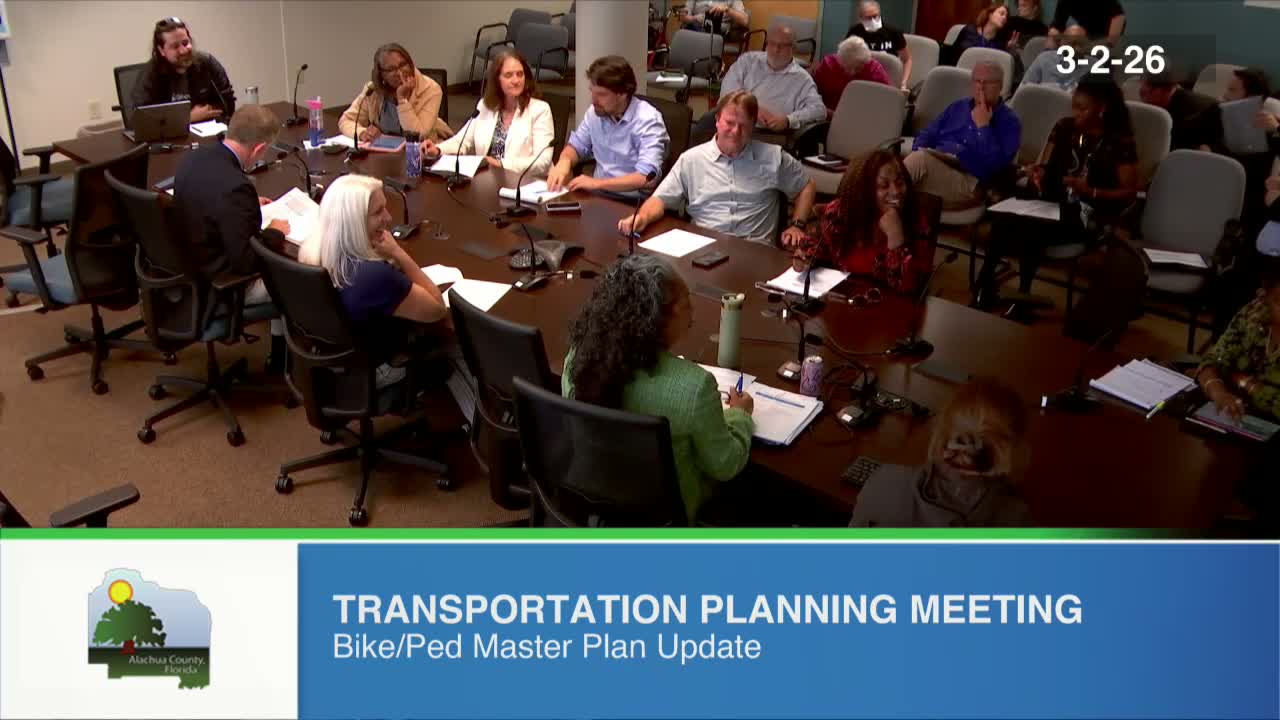
Allison Moss, deputy director for the TPO and transportation planning manager for Alachua County, presented an update on the countywide Bicycle & Pedestrian Master Plan. She described the project as a tool to make walking and biking attractive for people of all ages and abilities by creating goals, policies, programs and engineered projects. The outreach effort included two meetings, multiple pop‑ups and an online mapping/survey tool that received over 2,000 responses.
Staff outlined the network development and prioritization process: a nearly 500‑project build‑out was analyzed for connectivity, route directness and equity. Facility types considered include shared use paths (10‑foot off‑street paths), physically separated bike lanes (concrete preferred for durability), buffered bike lanes, bike boulevards and grade separations for high‑stress corridors. Feasibility checks included tree conflicts, curb relocations, drainage and utility impacts, and probable construction costs (drainage can make trail projects substantially more expensive).
The consultant team scored projects using six inputs (safety, healthy people/communities, connecting gaps, transportation disadvantage, multimodal integration and feasibility) and staff landed on a 65 (need) / 35 (feasibility) weighting to produce a prioritized list. A top‑20 project sample was shown for the city and for the county urban cluster. Staff will publish a web map and hold a public meeting (April 15) at the IFAS extension off Newberry Road and will finalize the master plan document for subsequent board review.
Commissioners asked questions about curb relocation, the mix of quick‑build options versus full reconstruction, design standards and how schools and high‑need areas were considered in the prioritization. Staff said costs and feasibility are baked into the scoring and that a toolkit of quick‑build options will be included in the plan to enable short‑term, lower‑cost interventions.
Next steps: publish the web map, continue outreach and return the full master plan to boards for final review and adoption.