Get Full Government Meeting Transcripts, Videos, & Alerts Forever!
Get email alerts on the Comprehensive Plan topic
No spam. Unsubscribe anytime.
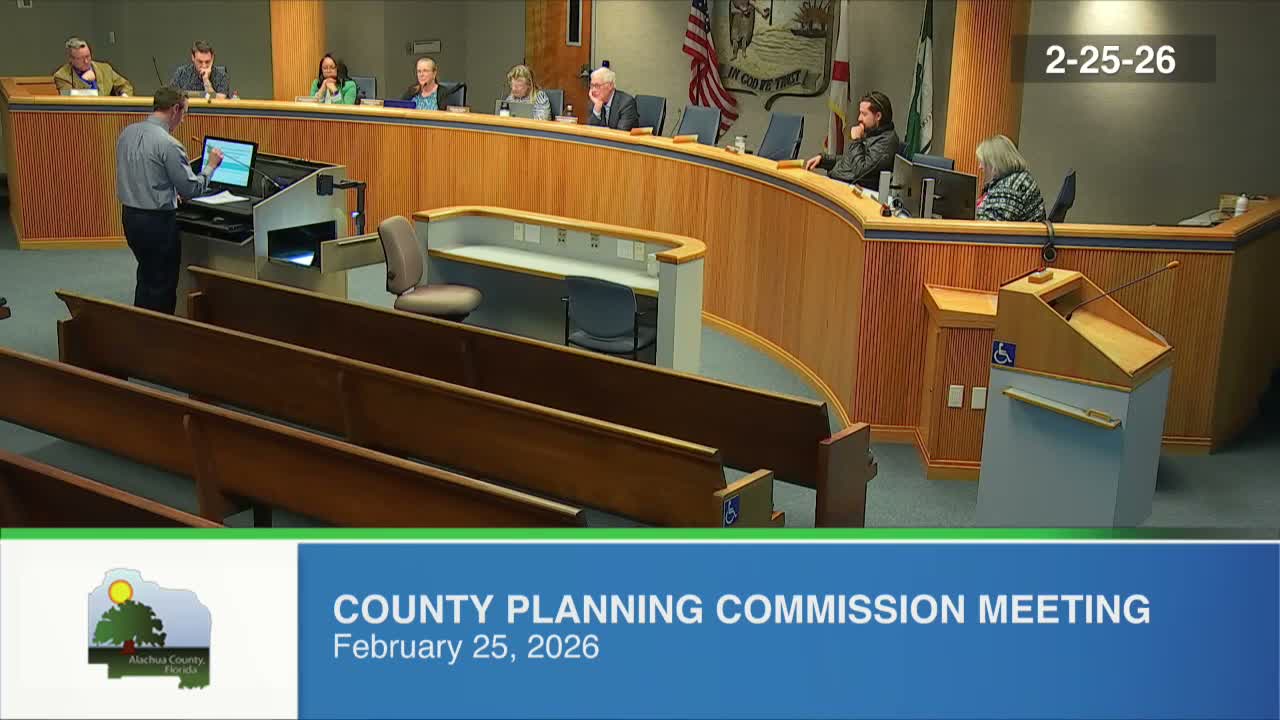
Planner Ben Chumley outlines statutory and technical updates to Alachua County comprehensive plan; hearing continued to March 11
Summary
At a special Planning Commission hearing, Principal Planner Ben Chumley presented Evaluation and Appraisal Report–based amendments to the Alachua County Comprehensive Plan focused on state-required updates and technical clarifications, including ENR septic rules, BMAP capital projects, workforce-housing references and circular-economy language; commissioners continued the hearing to March 11 for further review.
Ben Chumley, principal planner with the Alachua County Growth Management Department, presented a package of Evaluation and Appraisal Report (EAR)-based amendments to the Alachua County Comprehensive Plan at a special Planning Commission public hearing.
Chumley described the package as primarily statutory compliance and technical edits rather than a wholesale rewrite. "Our deadline to let the state know whether any updates were necessary was, 04/01/2025," he told the commission, adding that the county must transmit any amendments within a year of that notice (transmission by 03/31/2026) and that the state will take roughly 60 days to review transmitted amendments.
Why it matters: the EAR process is the statutory checkpoint that keeps the county's 20-year planning document aligned with state law and local priorities. Several items in this packet respond directly to recent state measures and to county board direction; others reflect ongoing planning efforts and will return for additional stakeholder review.
What staff proposed
- Statutory compliance and schedule: Staff grouped items that are required by state statute and recommended transmittal for state-coordinated review. Chumley warned the commission that Senate Bill 180 restricts the county's ability to adopt amendments considered "more restrictive or burdensome" from Aug. 1, 2024, through Oct. 1, 2027, which affects how some proposed local rules can be framed now.
- Future Land Use: Technical clarifications to Traditional Neighborhood Development design language, revisions to activity-center policies (including short-term flexibility in the East Side Activity Center), and generalization of outdated commercial land-use descriptors to better accommodate mixed-use development.
- Accessory dwelling units (ADUs) and housing: The presentation removes the existing requirement that applicants construct ADUs in the urban cluster (to make ADUs easier to build) while maintaining homestead/permanent-residency proof in rural areas. Staff also added a workforce-housing definition referenced throughout the housing element (staff cited roughly "120% of area median income" as the workforce-housing threshold used in discussion), consolidated manufactured-housing policies, and recommended language encouraging motel conversions to permanent supportive housing.
- Water quality and BMAPs: In the capital improvements and potable-water/sanitary-sewer elements, staff added a new table identifying Basin Management Action Plan (BMAP) capital projects attributable to Alachua County (a 2023 House Bill 1379 requirement) and incorporated enhanced nutrient-reducing (ENR) septic-system requirements for lots under 1 acre within BMAP areas.
- Solid waste and circular economy: The solid-waste element was revised to prioritize waste reduction, add circular-economy language (reuse, remanufacture, composting), and include broader compatibility and environmental-justice considerations for siting facilities; staff referenced the county's Ecoloop project in general terms.
- Conservation and dark-sky policy: Staff proposed deleting a static list of preservation areas in favor of a general preservation-area definition, recommended administrative review for minor wetland impacts (up to 0.25 acre for single-family homes), and added enabling language for dark-sky standards subject to later Land Development Code work and safety considerations.
- Community health: Additions include social-determinants-of-health language, support for aging-in-place programs, a policy recognizing the central receiving facility for mental-health and substance-abuse crises, and a policy reflecting the county commission's resolution declaring gun violence a public-health issue.
What commissioners pressed on
Commissioners asked staff to point to policy numbers in the packet when specifics were raised, to explain how SB 180 affects the draft language, and whether county goals (for example, recycling targets) should be retained or revised while the state updates its standards. Several commissioners asked for more time to review the voluminous materials; staff said the packet included a 28-page summary plus larger supporting documents and offered three follow-up dates.
Notable direct quotes
- "That letter then essentially started a clock... So that would be by 03/31/2026," Ben Chumley, principal planner.
- "That prohibition... applies from 08/01/2024 through 10/01/2027," Ben Chumley, on Senate Bill 180's timeframe and effect on county-initiated amendments.
- "Circular economy means a system where materials never become waste and nature is regenerated," Stacy Greco, Environmental Protection Department, Water Resources Program, defining the term during discussion of the solid-waste element.
Next steps and formal actions
Commissioners agreed to collect written comments and to focus future meetings on sections flagged by individual members to reduce staff burden. After discussion, the commission voted to continue the public hearing to March 11 at 6:00 p.m. for further review and possible additional meetings (March 4 and March 12 were also offered as options). No final county-adoption action occurred at this meeting; staff will transmit the package to the state for coordinated review after the commission's recommendation is finalized.
The commission called for any public comments not on the agenda (none were offered) and adjourned the meeting.