Get Full Government Meeting Transcripts, Videos, & Alerts Forever!
Get email alerts on the Jail Programs topic
No spam. Unsubscribe anytime.
Alachua County officials hear jail programs and mental-health update; hiring gains noted, caseloads remain high
Summary
At a special April 7 meeting, Alachua County commissioners received a quarterly update on jail programs, reporting new reentry partnerships, a new case-management system, hiring progress and mental-health statistics showing a heavy caseload and nearly 900 daily inmates.
Alachua County commissioners received a quarterly update April 7 on jail programs and mental-health services, where sheriff'office leaders highlighted new reentry partnerships, software to track outcomes and progress in filling detention vacancies while acknowledging persistently high mental-health caseloads.
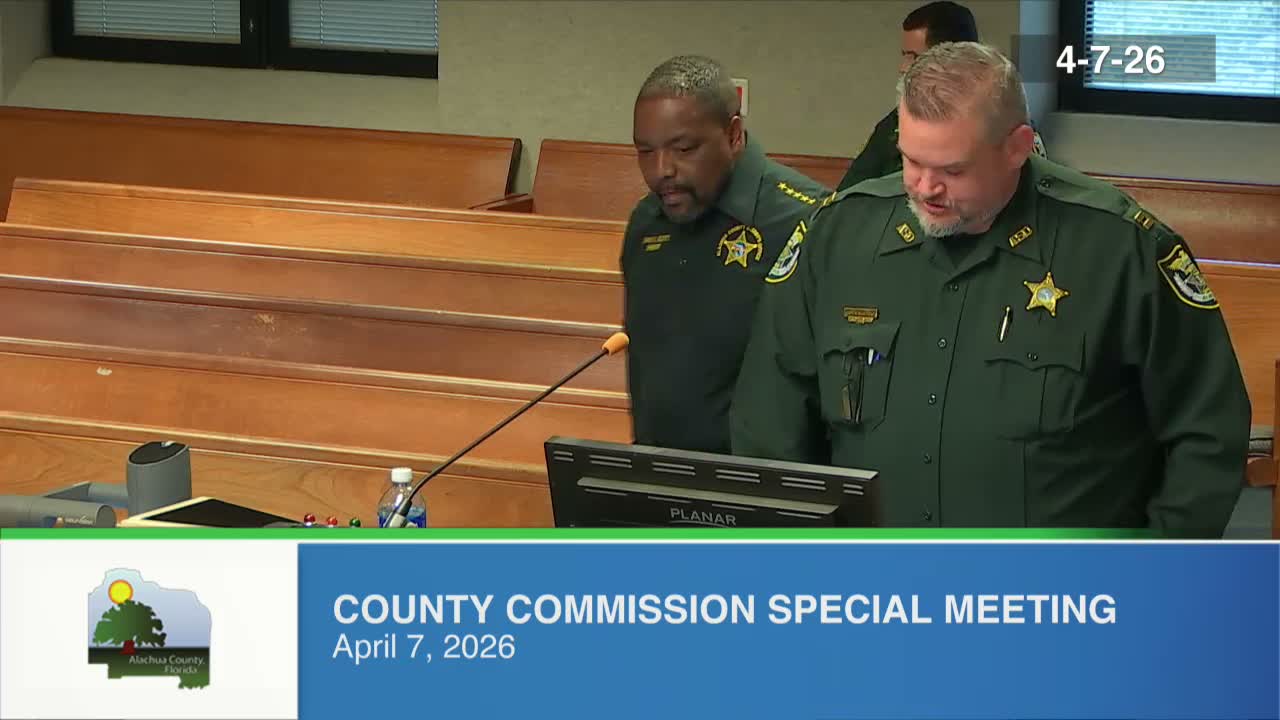
The presentation, delivered by Captain Swallows, division commander of support services, and introduced by Sheriff Scott, said the jail had 99 active volunteers as of last week and has expanded a policy allowing some justice-impacted individuals to serve as escorted volunteers after an administrative review. "As of, you know, last week, we had 99 volunteers," Swallows said, noting volunteers provide services inside the jail and help support reentry efforts.
Why it matters: Commissioners and community partners framed the update as part of efforts to reduce recidivism and ease pressure on local behavioral-health systems. Commissioners pressed for clearer participation metrics and better data sharing so the county can measure program impact.
Key programs and data - Casebook tracking software: The jail is implementing Casebook to record referrals and outcomes and to improve coordination with community partners. Staff said the system was newly purchased and is still being populated. Limited information-sharing between systems is possible but constrained by privacy considerations.
- Road to Success and Change programs: The Road to Success program (launched Dec. 2025) and a shorter-term Change program work on reentry planning and resource connections. Swallows reported the January'March transition cycle had 12 participants and eight completions; "Since 2020, there have been a total of 12 cycles with 180 participants," he said, adding 135 completers and 80 who had not been rearrested, a figure presented as a 59% reduction among completers.
- Screening and referrals: Since September 2025 the Change program screened 238 inmates and accepted 183; staff reported 30 people received help securing jobs, 44 were referred for placement, 40 obtained housing assistance, nine received relocation help, 15 were referred for food assistance and numerous referrals were made for SSI, transportation and education services.
- Education and tablets: The jail introduced Emilio tablets for juvenile education and to support reentry classes; staff said 20 tablets are dedicated to the juvenile program and that some connectivity problems exist in parts of the facility. Programs manager Takivia said IT is pursuing a booster to address a dead zone in the education area.
Staffing, inspections and population The presentation said that on Jan. 25 the administration inherited 68 certified detention-officer vacancies. Since then the sheriff'office hired 63 people; presenters reported 35 current vacancies (not including 17 people in the academy), 15 detention-officer recruits in the corrections academy and a graduation scheduled for May 5.
On oversight, Swallows said the jail passed the annual unannounced FMJS inspection on March 11. On health metrics, the contract medical provider Wellpath completed 498 initial behavioral-health evaluations and 247 new psychiatric visits from December through February; staff reported an average monthly mental-health caseload of 644 and a total average daily population of 908 for that period, with 880 inmates present the day of the meeting.
Questions from commissioners and staff Commissioners asked for more granular data on who is eligible for programs versus who participates, noting that headline counts (for example, the jail's total daily population) can be misleading without eligibility context. Takivia and Swallows said Casebook will allow better tracking over time but will require more time to populate with reliable participation data.
Commissioners also raised technical limits to tablet use; Takivia said the jail is using a guest Wi'Fi network and identified a dead zone near parts of the facility, and staff said they are pursuing a booster or other infrastructure fixes.
Public comment and community partners During public comment, resident Mr. Bunt urged better outcomes reporting, asking that morbidity and mortality data be included in future reviews and proposing closer law-library coordination for incarcerated people seeking legal resources. Emily Westerholm, founder and executive director of Release Reentry, thanked commissioners and the sheriff'office for accommodations that let staff with lived experience volunteer and said Release Reentry logged "93 hours of service" inside the jail in March. She also provided demographics: the group serves a predominantly male population (67%), with about 46% of participants experiencing homelessness and 17% having experienced an overdose and revival with naloxone.
What's next Commissioners requested a more detailed participation report next quarter and discussed scheduling a May 5 meeting to review related contracts and timelines. The board adjourned the special meeting and reconvened for a budget session at 1:30 p.m.
Sources: Remarks and data presented at the Alachua County Board special meeting, April 7; public comments by Release Reentry and Mr. Bunt.