Get Full Government Meeting Transcripts, Videos, & Alerts Forever!
Get email alerts on the Transit Rts topic
No spam. Unsubscribe anytime.
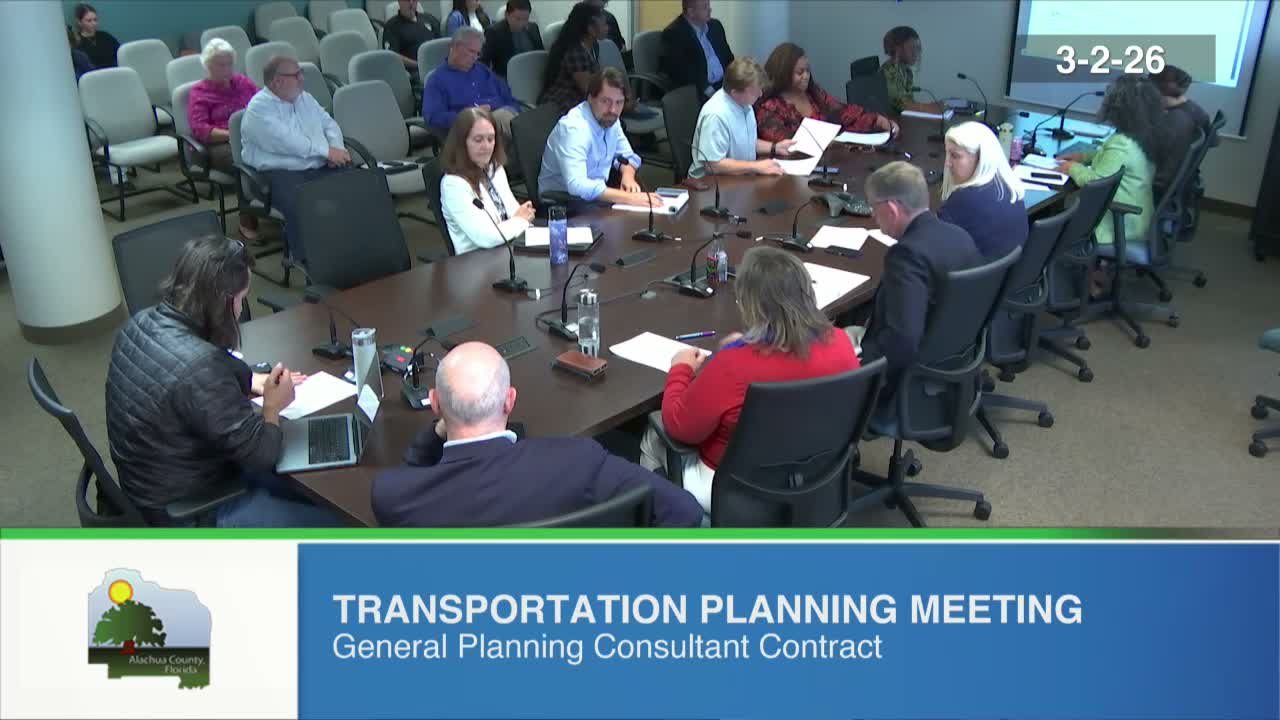
TPO hears RTS budget and service briefing; board invites UF and UF Health to help reshape countywide transit
Summary
After an RTS presentation on shrinking service, falling ridership and budget pressures, the TPO board unanimously moved to invite the University of Florida and UF Health to work with the TPO, city and county on improving ridership for faculty, staff and students and bolstering long‑term financial viability. Public commenters urged restored headways, paratransit access and clearer route signage.
Jesus Goma, RTS general manager, told the Gainesville–Alachua County TPO board that the transit system now operates about 24 city routes (down from 41 in 2018), a fleet near 100 buses and roughly 239 full‑time positions, and that service hours have fallen by about 100–120 thousand hours since 2018. “We went from 41 city routes in 2018 to 24 in 2025,” he said, and projected riders in 2026 at roughly 4.2 million — down from recent highs.
Dennis White, the city finance director, presented audited and draft financials, noting a $2 million city transfer in 2024 that caused a spike in city contributions and explaining that timing of receivables and capital purchases produce apparent year‑end deficits. White said recent year‑end positions showed a $5 million deficit in 2024 and a draft $6.6 million deficit for 2025, driven largely by capital timing and pension‑related transfers.
Commissioners questioned cost drivers, route selection criteria and the share of fixed versus variable costs. Commissioner Prizia asked whether route cuts were driven primarily by low productivity or by other constraints; Jesus Goma said productivity and available funding were primary factors. Board members repeatedly pressed for more and better data: how ridership counts were collected, plans to improve electronic fare collection, and whether long‑term commitments could be aligned among the city, county and the university.
A University of Florida representative said UF will continue to collaborate with the city and county and that the university is conducting a review of UF‑funded portions of RTS to “ensure the effective and efficient use of student resources.” The university noted that its current contract with RTS runs through June 30, 2027, and said it will use the coming months to determine next steps.
After extended discussion, Commissioner Cornell moved that the TPO invite UF and UF Health transportation teams to work with the TPO, city and county staff to evaluate how to improve ridership among faculty, staff and students and enhance RTS’s long‑term financial viability. The motion also requested RTS restore route information to bus stop signs and solicit community feedback on paratransit transitions; the board voted unanimously to approve the motion.
Public comment during and after the presentation emphasized headways, paratransit and safety. Bobby Rummer, coordinator of the Alachua County Labor Coalition, urged increased headways, longer operating hours including weekends, restoration of door‑to‑door ADA service and clearer route information on signs. “We need to increase headways. People cannot plan their lives around the many current headways,” he said. Several paratransit riders and advocates described phone wait times, missing trips during recent provider transitions, and difficulties using app‑based interfaces for those who cannot use smartphones.
The board asked staff to pursue a multi‑partner conversation on countywide transit funding and operations and to return with data and recommendations; staff committed to follow‑up, data sharing and coordination with UF and other partners.
The board’s immediate next step is the staff‑led coordination called for in the motion; no funding reallocations or new appropriations were enacted at the meeting.