Get Full Government Meeting Transcripts, Videos, & Alerts Forever!
Get email alerts on the County Budget topic
No spam. Unsubscribe anytime.
Alachua County officials warn state property-tax proposals could wipe out tens of millions from county budget
Summary
County staff told commissioners that several pending state proposals to expand homestead exemptions or eliminate property taxes on certain classes of property could reduce Alachua County general-fund revenue by tens of millions and create an initial shortfall estimated at roughly $24 million in a worst-case scenario; commissioners discussed hold-harmless provisions and the restricted nature of county funds.
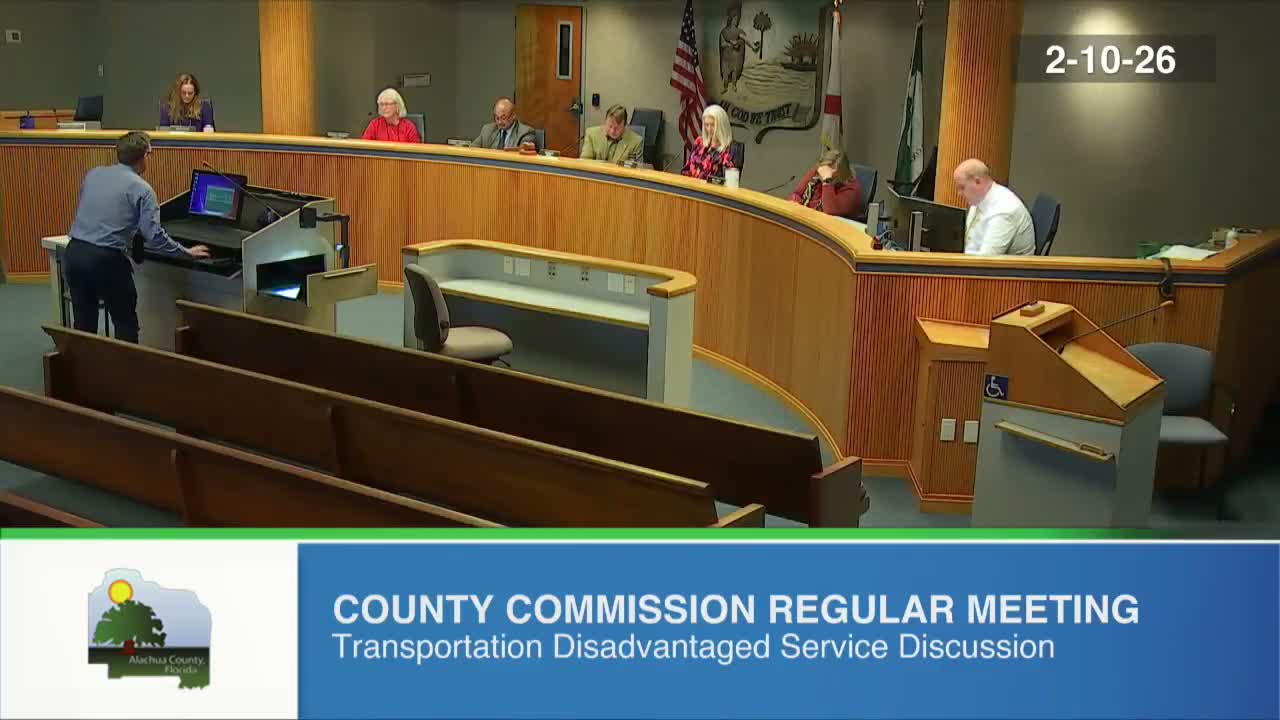
County finance officials on Feb. 10 gave commissioners a detailed briefing on how proposed state property-tax changes could affect local services and budgets, and outlined the specific programs that rely on property-tax revenue.
County Manager Michelle Lieberman and Budget Director Tommy Crosby explained the mechanics of millage rates, taxable versus assessed value, and the county’s historical reductions in millage since FY 2018. Lieberman said that Alachua County’s taxable value is reduced by homestead and institutional exemptions — she noted only 67.36% of assessed value is taxable in the county — which affects the county’s ability to generate revenue compared with other Florida counties.
Crosby presented cost drivers that have outpaced general inflation, including wages, benefits, construction and capital costs, and a municipal cost index that more closely tracks government purchasing than the consumer price index. He showed examples of escalations: construction cost per square foot and ambulance and fire-truck prices that have risen substantially since 2021.
Regarding pending state proposals, staff modeled several scenarios. A total elimination of property tax on homestead properties, based on current values, would reduce the county’s general fund by an estimated $85 million and leave the county with approximately $141 million in remaining general-fund revenue; a 10-year phase-down would spread that loss over time but still produce large cumulative reductions. Lieberman said those static estimates assume today’s population and tax base and that actual long-term effects would depend on behavioral and demographic changes.
"Property taxes remain the county’s most stable local revenue source but are influenced by market conditions, policy decisions and long-term cost pressures," Lieberman said. She emphasized that many county services are funded only from property-tax-derived general funds — for example, the supervisor of elections, portions of the clerk’s office, court services, juvenile detention obligations, the county’s Medicaid share, and the sheriff’s public-safety services.
If property-tax revenue were eliminated and the county still had to hold certain public-safety obligations harmless, staff said the county would begin from roughly a $24 million deficit and would have to find offsets or service reductions. Commissioners expressed concern about the scope of potential cuts and the difficulty of using other restricted revenue sources to fill gaps.
Commissioners asked staff to continue public outreach and to monitor state legislation; the county’s leadership also discussed putting information on the ballot and emphasized that constitutional amendments could be decided by votes in a small number of large counties that determine statewide outcomes.
The briefing concluded with several commissioners urging clearer public education about likely trade-offs between tax proposals and local services.