Get AI Briefings, Transcripts & Alerts on Local & National Government Meetings — Forever.
Alachua County Fire Rescue warns of prolonged burn ban as drought fuels multiple wildfires
Loading...
Summary
Chief Harold Theis told the county commission that Alachua County remains under a burn ban first issued 11/18/2025, is operating under a local state of emergency declared April 20, and is preparing staffing and mutual‑aid resources as wildfire risk and drought indices remain high.
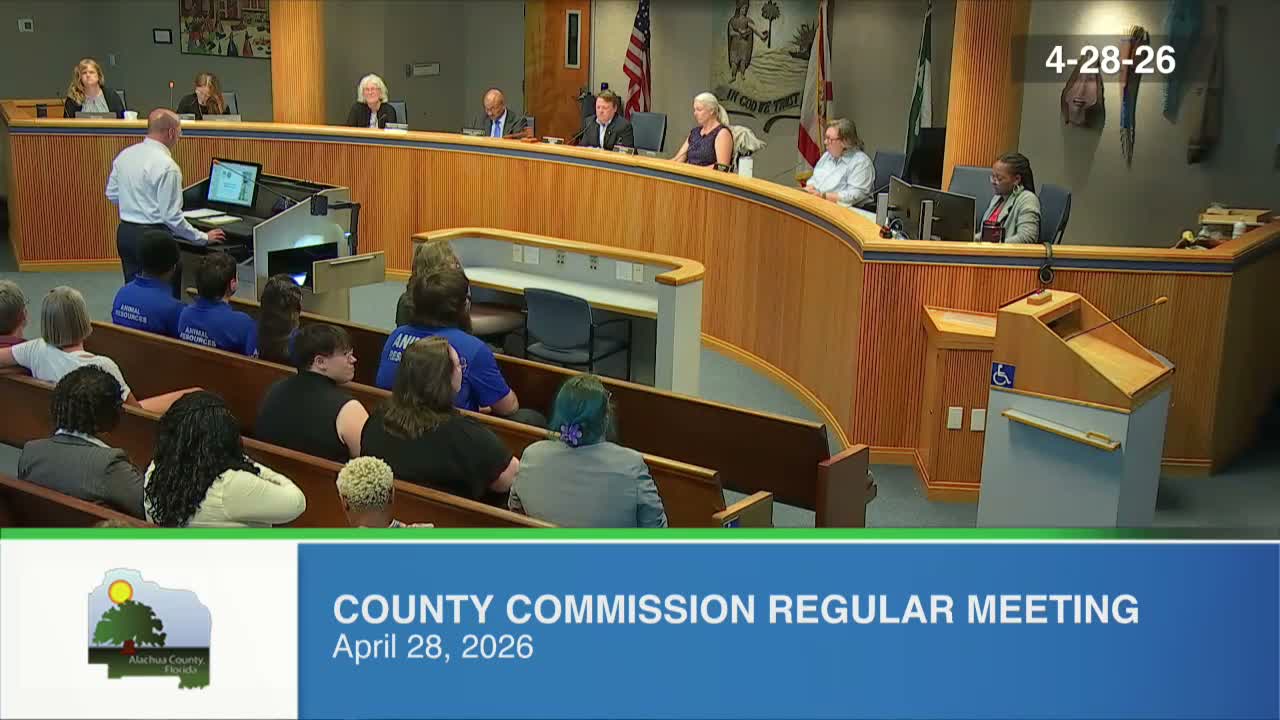
Chief Harold Theis of Alachua County Fire Rescue gave the Board an extended briefing on the county’s wildfire conditions and response plans, saying the county remains in a burn ban and continues to prepare for potential large brush fires.
“The burn ban…prohibits all outdoor burning. Any open flames, you cannot do in Alachua County,” Theis told commissioners, describing local rules that allow only enclosed cooking devices with chimneys or pipes and otherwise ban burn barrels, fireworks and debris burning.
Theis said the county’s burn ban was implemented 11/18/2025 and that the board’s April 20 local state of emergency remains in effect to signal seriousness and to provide procurement flexibility if needed. He listed several recent fires: two incidents on North State Road 121 and North Main Street (about 25 acres and 106 acres), a 302‑acre blaze on State Road 26 now about 70% contained, and a 134‑acre fire near Cross Creek that started in March. He added several smaller fires inside Gainesville city limits that the city had jurisdiction over and where county teams assisted.
To explain the high danger, Theis cited the Keetch‑Byram Drought Index — “Alachua County is in the 660 range,” he said — and flagged that parts of the county are in extreme and exceptional drought. He also noted the regional picture: a 2,300‑acre blaze in Levy County and a nearly 5,000‑acre event along the Putnam/Clay line that required mutual aid.
Theis described operational steps: suspension of some collective‑bargaining provisions to allow flexible staffing, up‑staffing of brush trucks and water tankers, cross‑staffing plans across engine crews and pre‑positioning of resources. He credited the Florida Forest Service and local departments for air and dozer support and said the county’s emergency management and regional automatic‑aid systems remain on daily standby.
He also emphasized public measures: the Florida Forest Service has suspended broadcast and pile‑burning permits in the five‑county region, and officials urge residents to keep yard debris at least 30 feet from homes, maintain buffer zones, consider hose lines that reach around properties, and use alert apps and evacuation plans if needed.
Commissioners asked several follow‑ups, including whether the National Guard could assist. Theis said the Guard would not be used to directly fight fires but could be requested through state emergency channels to help evacuation, food distribution and traffic control if a large wildfire triggered an activated emergency operations center.
Theis concluded by urging prudence: small ignition sources — from a flat tire to a rail‑car spark — can become large fires under current conditions. He said the county would continue coordinating with the Florida Forest Service and neighboring jurisdictions and would review staffing and supply needs weekly as conditions evolve.
Next steps: county communications will increase public outreach about prevention and safety, staff said, and the board agreed to post high‑fire‑risk signage on county conservation lands and to expand social‑media guidance.